
Table of Contents
How Many Days After Ovulation Does Implantation Happen?
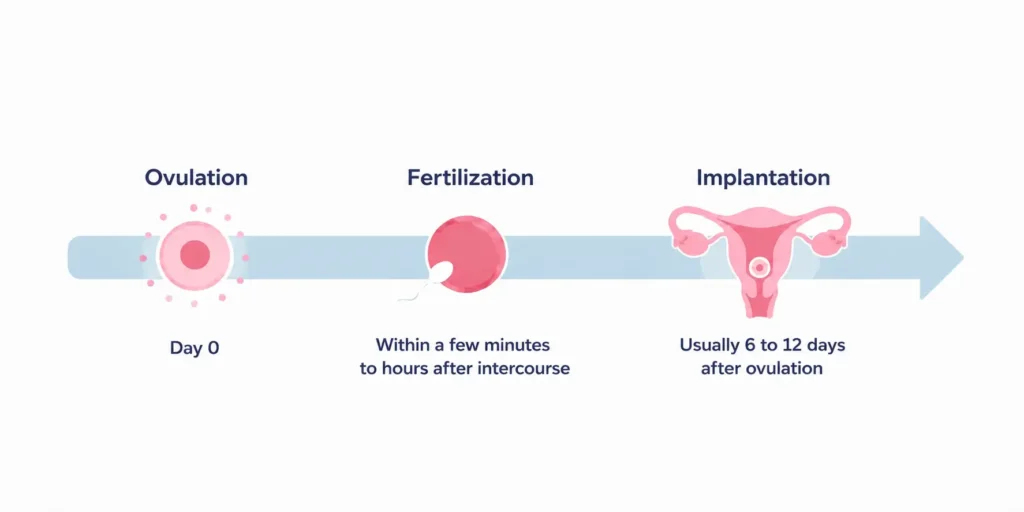
After ovulation, your body goes through several important steps before implantation can happen, and many women want to know exactly how many days after ovulation does implantation happen. When ovulation occurs, an egg is released from the ovary and moves into the fallopian tube. If sperm meets the egg during this time, fertilization may occur, and the fertilized egg begins dividing as it develops into an embryo. If you’re not sure exactly when you ovulated, our Ovulation Calculator can help you pinpoint it first.
Over the next few days, the developing embryo travels through the fallopian tube toward the uterus while continuing to grow. It eventually reaches the blastocyst stage, when it is ready to attach to the uterine lining. According to Mayo Clinic, implantation typically occurs 6 to 10 days after fertilization. This attachment is called implantation and usually happens several days after ovulation, rather than immediately after fertilization.
If you want to understand exactly how implantation happens, you can read our What Is Implantation? guide.
The timing can vary from one pregnancy to another because ovulation and implantation do not happen on exactly the same day for everyone. If you’re trying to estimate when you ovulated, our Ovulation Calculator can help you get an approximate date.
In simple terms, the process is: Ovulation → Fertilization → Embryo development → Travel to the uterus → Implantation. This timeline also explains why a pregnancy test may not be positive immediately after ovulation.
If you want an easier way to estimate this, you can use our Implantation Calculator to get a quick estimate based on your ovulation date.
How Many Days After Ovulation Does Implantation Happen?
Implantation usually happens about 6 to 12 days after ovulation, with many pregnancies implanting around 8 to 10 days after ovulation. This means implantation does not happen immediately after ovulation or fertilization.
After the egg is fertilized, the developing embryo continues traveling toward the uterus and growing. Once it reaches the blastocyst stage, it can attach to the uterine lining and begin implantation.
The exact timing can vary from person to person and from one pregnancy to another. So, being a few days earlier or later does not necessarily mean anything is wrong.
If you want to see what may happen during each day after ovulation, you can read our Implantation Symptoms Day by Day (1–12 DPO) guide.
If you’re wondering when a pregnancy test may become accurate after implantation, see our When to Take a Pregnancy Test guide.
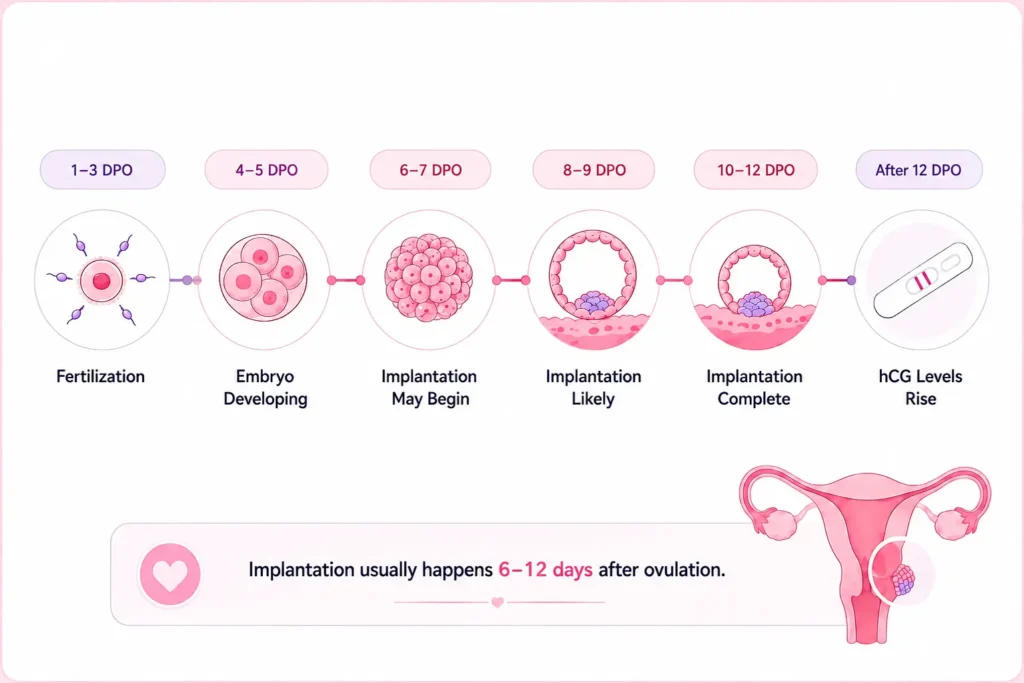
Implantation Timeline by DPO
1–3 DPO:
After ovulation, fertilization may occur if sperm meets the egg. If fertilization happens, the early embryo begins dividing and continues moving through the fallopian tube toward the uterus. Implantation has not happened yet.
4–5 DPO:
The developing embryo continues traveling toward the uterus and becomes more developed. It is getting closer to the stage where it can attach to the uterine lining, but implantation usually has not started yet.
6–7 DPO:
This is around the time when implantation may begin for some pregnancies. The blastocyst may reach the uterus and start attaching to the uterine lining.
8–9 DPO:
Implantation commonly occurs around this part of the timeline for many pregnancies.
10–12 DPO:
By this stage, implantation may have already occurred. Some pregnancy tests may start detecting hCG around this time, though it’s still early for reliable results.
Implantation timing directly affects when a pregnancy test turns positive. Once implantation happens, your body starts producing hCG, the hormone pregnancy tests detect, but levels are very low at first and rise gradually over the following days. This is why hCG isn’t usually detectable right away, and if implantation happens later than expected, it takes even longer for hCG to build up enough for a positive result.
This is also the main reason testing too early can give a false negative even when pregnancy has occurred. If you test and get a negative result but your period still doesn’t come, wait a few more days and test again, since hCG levels rise quickly as the days pass.
For the best timing and more details, read our guide on When to Take a Pregnancy Test.
Earliest Day Implantation Can Happen
The earliest implantation can typically happen is around 6 DPO, though it is not very common this early. Many women who track their cycles closely want to know how many days after ovulation does implantation happen at its earliest, and 6 DPO is generally considered the starting point of the normal range. At this stage, the embryo has just reached the blastocyst stage and is only beginning to attach to the uterine lining, so the process is still in its very initial phase.
Implantation happening this early is usually linked to a faster-developing embryo or a uterine lining that became receptive a little sooner than average. It does not mean anything is wrong if implantation happens later than 6 DPO, since this is simply the earliest point in the normal range rather than the typical one.
Most pregnancy tests will not detect anything this early even if implantation has occurred, since hCG levels take a few more days to build up enough to show a positive result. So while 6 DPO is possible, it is usually too soon to test with reliable results.
Latest Day Implantation Can Happen
The latest day implantation usually happens is around 12 DPO, though in rare cases it can extend slightly beyond this. If you’re wondering how many days after ovulation does implantation happen on the later side, 10 to 12 DPO is considered the upper end of the normal range, and going a day or two past this is still not something to worry about.
Implantation happening later often just means the embryo took a little more time to reach the blastocyst stage, or the uterine lining took a bit longer to become fully receptive. Both of these are completely normal variations and don’t necessarily point to any problem with the pregnancy.
Because implantation is happening later in these cases, hCG levels also take longer to rise, which means a pregnancy test may stay negative for a few extra days compared to someone whose implantation happened earlier. So if your period is late and your test is still negative, it doesn’t automatically mean you’re not pregnant, it may just mean implantation happened closer to the later end of the timeline.
Why Does Implantation Timing Vary From Person to Person?
Implantation timing is not the same for every woman, and there are a few real reasons behind this. Every woman’s cycle length is different, so ovulation itself can happen earlier or later depending on the person. Since implantation depends on when the egg was fertilized, a shift in ovulation naturally shifts implantation too.
The health of the embryo also plays a role. Some embryos divide and grow a little faster or slower than others in the first few days, and this affects how quickly they are ready to attach to the uterine lining. The condition of the uterine lining matters as well. A lining that is thick and receptive at the right time allows implantation to happen smoothly, while a lining that is not fully ready yet can delay the process by a day or two.
Hormone levels, especially progesterone, also influence this timing since they prepare the uterus for the embryo. Even small differences in hormone balance from one woman to another can push implantation earlier or later. This is why some women notice implantation symptoms around 6 DPO while others don’t notice anything until 10 or 12 DPO, and both can be completely normal.
Does Fertilization Happen Right After Ovulation?
Fertilization does not always happen the exact moment ovulation occurs, but it does happen fairly quickly if sperm is present. Once the egg is released from the ovary, it only survives for about 12 to 24 hours. If sperm is already waiting in the fallopian tube, or arrives within this window, fertilization usually takes place within a few hours of ovulation.
Sperm, on the other hand, can survive inside the female body for up to 5 days under the right conditions. This is why fertilization can technically happen even if intercourse occurred a few days before ovulation, since the sperm simply waits for the egg to be released. But if there is no sperm available within that 12 to 24 hour window after the egg is released, the egg breaks down and fertilization does not happen that cycle.
So while fertilization is often described as happening “right after ovulation,” the more accurate picture is that it happens within a short window following ovulation, and the exact timing depends on when sperm meets the egg inside the fallopian tube.
Can You Feel Implantation at a Specific DPO?
Most women cannot feel the exact moment implantation happens, but some do notice mild signs around a specific DPO range, usually between 6 and 12 DPO. This is the window when the fertilized egg attaches to the uterine lining, so any sensations linked to implantation tend to show up somewhere in this range rather than on one fixed day for everyone.
Common signs some women report include light cramping, mild pinching or pulling sensations low in the abdomen, and sometimes very light spotting known as implantation bleeding. These sensations, if they happen at all, are usually much lighter than period cramps and only last a short while.
It’s important to understand that many women feel nothing at all during implantation, and that is completely normal too. The body does not always give noticeable signals for something happening on a cellular level. So while it is possible to feel mild symptoms around a specific DPO, the absence of any feeling does not mean implantation hasn’t occurred.
What If Implantation Hasn't Happened by 10 DPO?
If implantation has not happened by 10 DPO, it does not automatically mean something is wrong. The typical implantation window is 6 to 12 DPO, so 10 DPO still falls within the normal range, and many women’s implantation happens a little later, closer to day 11 or 12.
A pregnancy test at this point may still show negative or a very faint line, simply because implantation hasn’t happened yet, so there isn’t enough hCG in the body to detect. This is different from implantation failing altogether. As long as implantation eventually happens within the normal window, a slightly later timing on its own is not a cause for concern.
If a woman reaches 14 DPO or beyond with no signs of implantation and a negative test, and her period still hasn’t started, that is usually when it makes more sense to test again or check in with a doctor, since at that point either implantation happened without obvious symptoms, or the cycle did not result in pregnancy this time.
Once implantation is confirmed, you can use our Due Date Calculator to get an early estimate of your delivery date.