In This Article..
What Is Fertility Treatment?
Fertility treatment refers to medical treatments that can help people who are having difficulty getting pregnant. The type of treatment recommended depends on the reason for infertility, the couple’s health, age, and other factors.
Some fertility treatments help the ovaries release an egg, while others help sperm reach the egg or help an embryo develop and implant in the uterus.
Common fertility treatments include ovulation induction, intrauterine insemination (IUI), in vitro fertilization (IVF), and intracytoplasmic sperm injection (ICSI).
Fertility treatment does not look the same for everyone. A doctor may recommend one treatment or a combination of treatments after evaluating both partners and identifying possible causes of infertility.
If you are considering IVF, you can use our IVF Due Date Calculator to estimate your pregnancy due date based on your embryo transfer date and embryo age.
When Should You Consider Fertility Treatment?
Many couples need some time to conceive, so not getting pregnant right away does not always mean there is a fertility problem. However, it may be a good idea to talk with a doctor if pregnancy has not occurred after regular, unprotected sex.
For most couples, a fertility evaluation is recommended after:
12 months of trying if the woman is under 35.
6 months of trying if the woman is 35 or older.
Sooner than 6–12 months if there are known fertility problems or concerns, such as irregular or absent periods, previous pelvic surgery, endometriosis, or a known sperm-related problem.
You may also want to seek medical advice sooner if you have very irregular periods, repeated pregnancy loss, or a history that could affect fertility.
A fertility evaluation does not automatically mean you will need IVF or another advanced treatment. Your doctor may first identify the possible cause and recommend the simplest suitable option.
If you are tracking your fertile days while trying to conceive, our Ovulation Calculator can help you estimate your likely ovulation date and fertile window.
Common Types of Fertility Treatment
There are several types of fertility treatment, and the right option depends on what is causing difficulty with conception. Some treatments are simple and involve medication, while others use medical procedures to help fertilization happen.
Ovulation Induction
Ovulation induction uses medication to help the ovaries release an egg. It may be recommended for women who do not ovulate regularly or do not ovulate at all.
The doctor may monitor the ovaries with blood tests or ultrasound to determine when ovulation is likely to occur. Ovulation induction may sometimes be combined with timed intercourse or IUI
IUI (Intrauterine Insemination)
IUI is a fertility treatment in which prepared sperm is placed directly into the uterus around the time of ovulation. This gives sperm a shorter distance to travel to reach the egg.
IUI may be used for certain cases of unexplained infertility, ovulation problems, or some sperm-related fertility issues. It is generally less invasive than IVF.
IVF (In Vitro Fertilization)
IVF is a treatment in which eggs are collected from the ovaries and fertilized with sperm in a laboratory. If fertilization results in an embryo, an embryo can then be transferred into the uterus.
IVF may be recommended for several fertility problems, including blocked fallopian tubes, some cases of male infertility, endometriosis, or when other treatments have not worked.
ICSI (Intracytoplasmic Sperm Injection)
ICSI is a procedure usually performed as part of IVF. Instead of allowing sperm and egg to fertilize on their own in the laboratory, a single sperm is directly injected into an egg.
ICSI may be considered when there are certain male-factor fertility problems, previous IVF fertilization problems, or other specific circumstances. The doctor will decide whether ICSI is appropriate based on the individual situation.
How Does Fertility Treatment Work?
Fertility treatment usually starts with finding out why pregnancy is not happening. A fertility specialist may review your medical history and menstrual cycle and may recommend tests for both partners. These can include hormone tests, an ultrasound, or a semen analysis.
Once the possible cause is identified, the doctor chooses a treatment plan based on your individual situation. Some people may need medication to support ovulation, while others may need a procedure such as IUI or IVF.
Treatment is often carried out in stages. Your doctor may monitor your cycle, check how your body responds to medication, and adjust the treatment if needed. If an egg is fertilized and an embryo is created, the next steps will depend on the type of treatment being used.
The length of fertility treatment can vary. Some treatments may take place within one menstrual cycle, while treatments such as IVF usually involve several steps over a number of weeks.
Important: Fertility treatment is not a one-size-fits-all process. Your doctor will recommend the approach that is most appropriate for your fertility needs, age, test results, and overall health.
IVF vs. IUI: What's the Difference?
IUI and IVF are both fertility treatments, but they work in different ways. The main difference is where fertilization happens. With IUI, fertilization is expected to happen inside the body. With IVF, the egg and sperm are brought together in a laboratory before an embryo is transferred to the uterus.
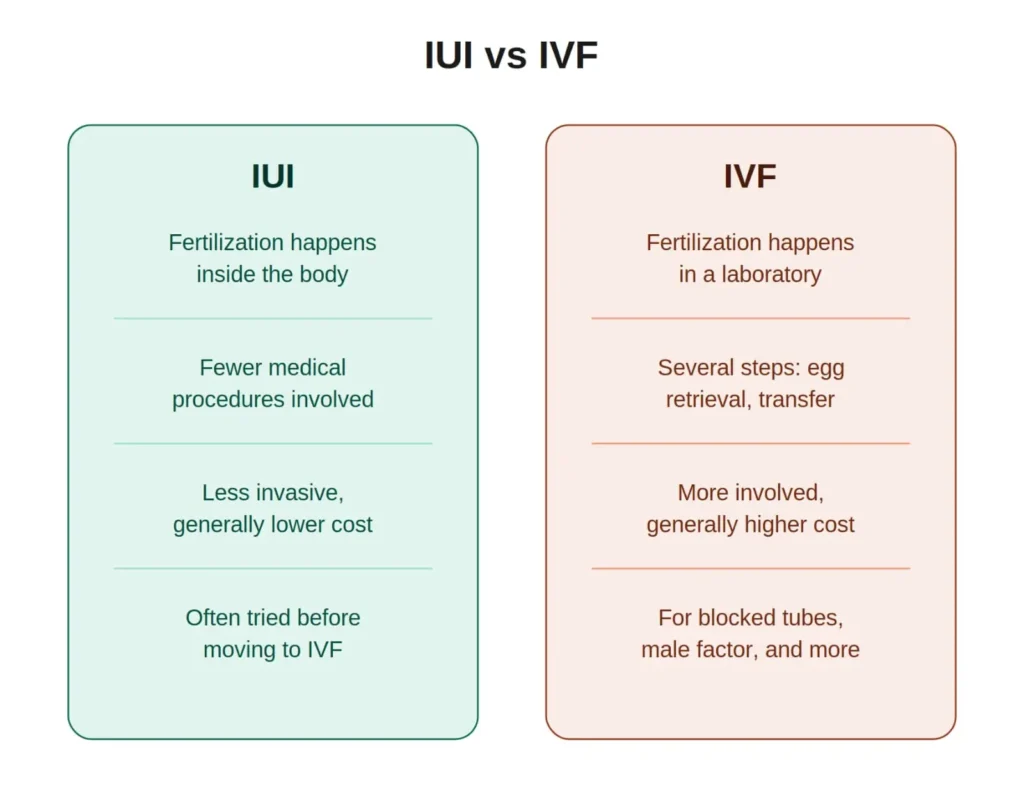
| IUI | IVF |
|---|---|
| Prepared sperm is placed directly into the uterus. | Eggs are collected and fertilized in a laboratory. |
| Fertilization happens inside the body. | Fertilization happens outside the body. |
| Usually involves fewer medical procedures. | Involves several steps, including egg retrieval and embryo transfer. |
| Generally less invasive. | More involved and usually more expensive. |
| May be suitable for some couples with unexplained infertility or certain ovulation or sperm-related problems. | May be recommended for conditions such as blocked fallopian tubes, certain male-factor infertility, or when other treatments have not worked. |
The best option depends on the cause of infertility, age, fertility test results, and previous treatment. IUI is not always a step that must come before IVF; a fertility specialist can recommend the most appropriate treatment based on your individual situation.
If you are trying to decide between IUI and IVF, understanding their success rates can help you have a clearer conversation with your fertility specialist. Success can vary widely depending on factors such as age, the cause of infertility, egg and sperm health, and the treatment cycle. IUI vs. IVF Success Rates can help explain these differences and what may affect the chances of pregnancy with each treatment.
How Long Does Fertility Treatment Take?
The length of fertility treatment depends on the type of treatment, your menstrual cycle, and how your body responds. Some treatments may take place within one cycle, while others can take several weeks or longer.
Ovulation induction may be completed within one menstrual cycle, although some people need several cycles before moving to another treatment.
IUI is also usually planned around the menstrual cycle. Medication may be given to support ovulation, followed by monitoring and the IUI procedure around the expected time of ovulation.
IVF generally takes longer because it involves several steps, including ovarian stimulation, monitoring, egg retrieval, fertilization, embryo development, and embryo transfer. A fresh embryo transfer may happen within the same treatment cycle, while a frozen embryo transfer may be planned for a later cycle.
The exact timeline is different for everyone. Your fertility specialist will explain each step and let you know how long your particular treatment is expected to take.
What Happens After IVF or IUI?
After IUI or IVF, the next step is usually waiting to find out whether pregnancy has occurred. The timing and process can be slightly different for each treatment.
After IUI
After an IUI, you can usually return to your normal daily activities unless your doctor gives you different instructions. You may notice mild cramping or light spotting, but these symptoms do not necessarily mean that pregnancy has occurred.
A pregnancy test is usually taken about two weeks after IUI. Testing too early may give an unclear or inaccurate result, especially if fertility medication containing hCG was used.
If you’re wondering whether these symptoms could mean implantation is happening, our Implantation Calculator can help you estimate the likely implantation windo
After IVF
After an embryo transfer, the embryo needs time to implant in the uterine lining. Some people notice mild cramping or spotting, while others have no symptoms at all. Pregnancy symptoms are not a reliable way to know whether the transfer was successful.
Your fertility clinic will usually schedule a blood pregnancy test around 9–14 days after embryo transfer, depending on the clinic and type of transfer. If the test is positive, further blood tests or an early ultrasound may be recommended to monitor the pregnancy.
If IVF results in pregnancy, the embryo transfer date and embryo age can be used to estimate the pregnancy due date.
How Is Pregnancy Due Date Calculated After IVF?
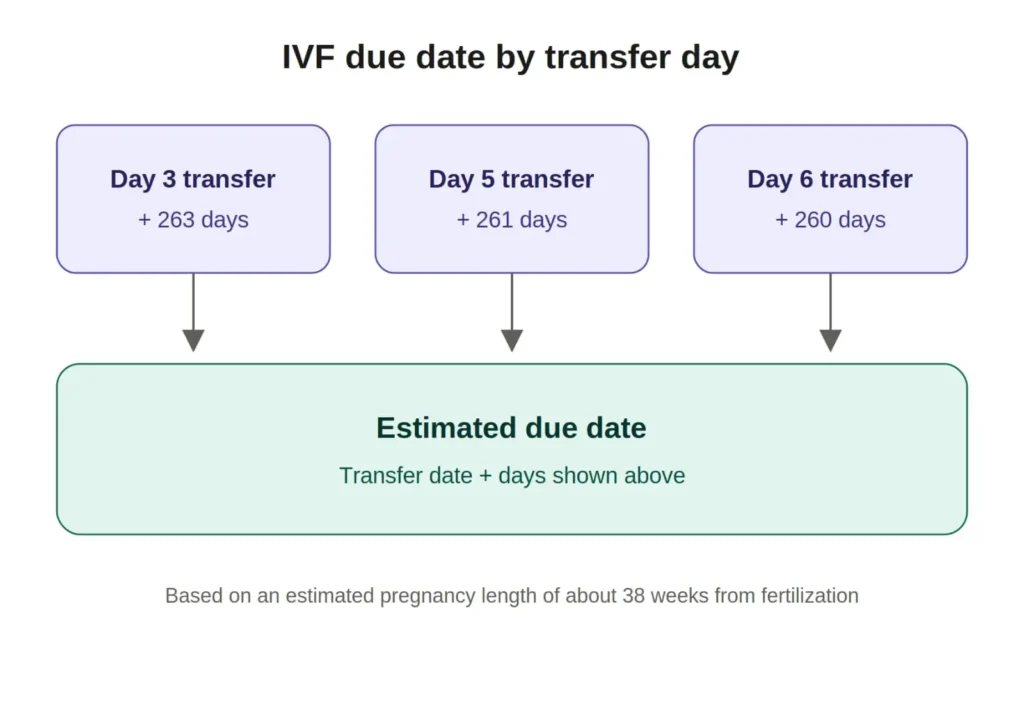
Calculating a pregnancy due date after IVF is slightly different from calculating a due date from the last menstrual period. Since the exact date of fertilization and embryo transfer is known, the due date can be estimated using the embryo’s age and transfer date.
For example, a Day 5 embryo transfer means the embryo was already five days old when it was transferred. A Day 3 embryo transfer means the embryo was three days old at transfer. This information is included when estimating the pregnancy due date.
The estimated due date is generally calculated as follows:
Day 3 embryo transfer: Transfer date + 263 days
Day 5 embryo transfer: Transfer date + 261 days
Day 6 embryo transfer: Transfer date + 260 days
These calculations estimate a pregnancy length of about 38 weeks from fertilization. Your healthcare provider may give you a slightly different date based on your individual circumstances.
Once you know your expected due date range, you can also use our Due Date Calculator to plan ahead
For more information about infertility and available treatment options, you can also visit the ASRM or Mayo Clinic.
Get Weekly Pregnancy & Fertility Tips
Get helpful, evidence-based insights on implantation, early pregnancy, fertility, ovulation, and pregnancy testing, delivered straight to your inbox every week.
Frequently Asked Questions
What is fertility treatment?
Fertility treatment includes medical treatments that can help people who are having difficulty getting pregnant. The treatment depends on the cause of infertility and may include medication, IUI, IVF, or other approaches.
When should I consider fertility treatment?
If you have been trying to conceive for 12 months without pregnancy and are under 35, it is generally recommended to speak with a fertility specialist. If you are 35 or older, consider seeking an evaluation after 6 months of trying. You may need to seek help sooner if you have irregular periods or a known fertility problem.
Is IVF the only fertility treatment?
No. IVF is just one option. Depending on the situation, treatment may include ovulation medication, timed intercourse, IUI, or other approaches. A doctor can recommend the most suitable option after evaluating the possible cause of infertility.
How long does fertility treatment take?
The timeline varies depending on the treatment and individual circumstances. Some treatments can be completed within one menstrual cycle, while IVF may take several weeks and sometimes involves more than one cycle.
Is IUI better than IVF?
Neither treatment is automatically better for everyone. IUI is less invasive and may be suitable for certain fertility problems, while IVF may be recommended when more advanced treatment is needed. Your doctor can help determine which option is appropriate for you.
Can I calculate my due date after IVF?
Yes. An IVF due date can be estimated using the embryo transfer date and embryo age. Our IVF Due Date Calculator can help you estimate your expected due date after a Day 3, Day 5, or Day 6 embryo transfer.
Does fertility treatment guarantee pregnancy?
No fertility treatment can guarantee pregnancy. Success depends on several factors, including age, the cause of infertility, egg and sperm health, and the type of treatment used. Your fertility specialist can explain your individual chances and treatment options.