
Table of Contents
What Is a Chemical Pregnancy?
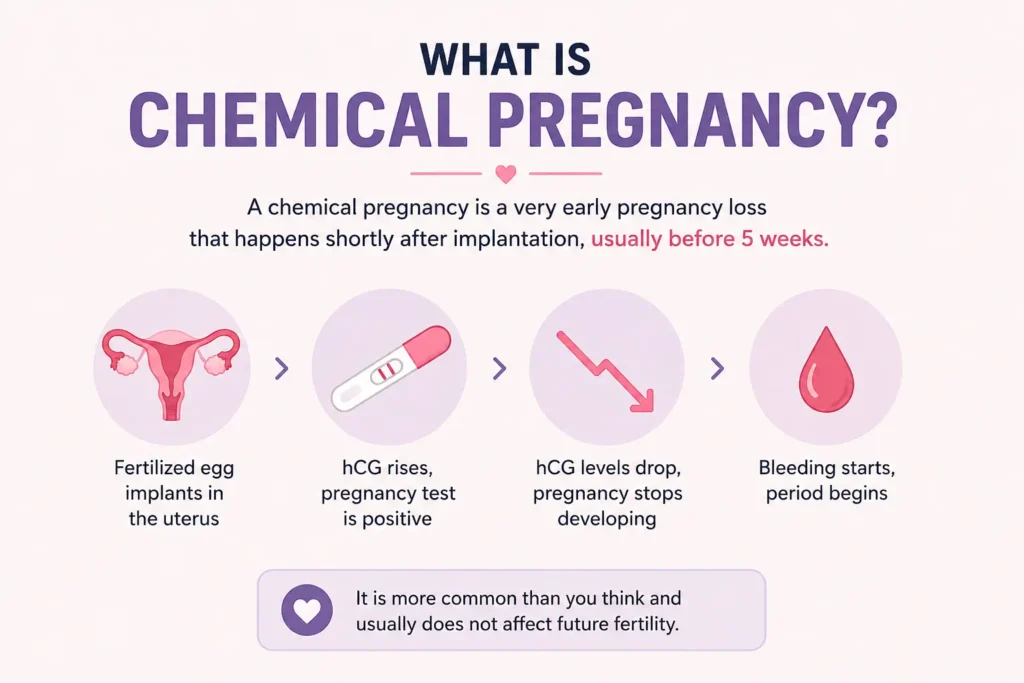
A chemical pregnancy is a very early pregnancy loss that happens shortly after implantation, usually before 5 weeks of pregnancy. It’s called “chemical” because the pregnancy is only confirmed through the pregnancy hormone (hCG) in a blood or urine test, not through an ultrasound, since it’s too early to see anything on a scan.
Here’s what typically happens: the fertilized egg implants in the uterus (see our implantation symptoms day by day guide to know what this stage usually feels like), hCG levels start to rise, and a pregnancy test may even come back positive. But then the pregnancy stops developing, and your body starts your period, often just a few days later than expected.
Many women who have a chemical pregnancy don’t even realize what happened. It can simply feel like a regular period that came a little late or was slightly heavier or more crampy than usual. If you’re ever unsure whether what you’re experiencing is implantation or your period, our Implantation Vs Period Calculator can help you compare the two. It’s only when someone tests very early, or is actively trying to conceive and tracking closely, that a chemical pregnancy gets noticed at all.
It’s important to know that a chemical pregnancy is not caused by anything you did. In most cases, it happens because the embryo had a chromosomal issue that stopped it from developing further, something completely outside your control.
How Common Is a Chemical Pregnancy?
Chemical pregnancies are quite common, but the exact number is difficult to determine because many occur so early that a person may never know they were pregnant. A chemical pregnancy happens after implantation, when a pregnancy test detects human chorionic gonadotropin (hCG), but the pregnancy stops developing before it can be seen on an ultrasound.
Research estimates that chemical pregnancies may account for a significant proportion of very early pregnancy losses. Some estimates suggest that around 10–20% of recognized pregnancies end in miscarriage, while chemical pregnancies make up many of the losses that occur before an ultrasound can confirm a pregnancy. The exact percentage varies because very early losses are often not detected or reported.
The increasing use of sensitive home pregnancy tests means that more people can now detect pregnancies that might previously have gone unnoticed. This can make chemical pregnancies seem more common, but it also means that very early pregnancy losses are being recognized more often.
Having one chemical pregnancy does not usually mean there is a problem with your fertility. Most people who experience one can become pregnant again and go on to have a healthy pregnancy. If chemical pregnancies happen repeatedly, however, it is worth discussing them with a healthcare provider, who may recommend further evaluation.
Signs and Symptoms of a Chemical Pregnancy
A chemical pregnancy can be difficult to recognize because it happens very early, often before an ultrasound can confirm a pregnancy. Some people may have no noticeable symptoms, while others notice changes after getting a positive pregnancy test.
Common signs and symptoms may include:
A positive pregnancy test followed by a negative test: hCG may initially be high enough to produce a positive result, but as the pregnancy stops developing, hCG levels begin to fall and the test may become negative.
Vaginal bleeding: Bleeding may occur around the time your period is expected and can sometimes be heavier than your usual period.
Mild to moderate cramping: Lower abdominal or pelvic cramps may occur as the body passes the pregnancy tissue.
A late or unusual period: Your period may arrive a few days later than expected or seem different from your normal menstrual bleeding.
Early pregnancy symptoms that disappear: Symptoms such as breast tenderness, fatigue, or nausea may fade as hCG levels decrease.
A drop in hCG levels: Blood testing may show that hCG is falling rather than increasing as expected in an early pregnancy.
It is important to remember that these symptoms alone cannot confirm a chemical pregnancy. Bleeding and cramping can also occur during an early healthy pregnancy or for other reasons. A healthcare provider can use pregnancy tests, blood hCG measurements, and, when appropriate, ultrasound to determine what is happening.
If you have heavy bleeding, severe or one-sided abdominal pain, dizziness, fainting, or fever, seek medical care promptly.
How Long Does a Chemical Pregnancy Last?
A chemical pregnancy occurs very early, usually shortly after implantation and before the pregnancy can be seen on an ultrasound. Because it happens so early, the physical part of a chemical pregnancy often lasts only a few days to about a week, although the timing can vary from person to person.
After the pregnancy stops developing, hCG levels gradually begin to fall. As hCG decreases, bleeding may begin around the time your period is expected or a few days later. The bleeding can be similar to a normal period, although some people may experience heavier bleeding or stronger cramps than usual.
Pregnancy tests can remain positive for a short time because hCG does not disappear immediately. As the hormone level falls, the test line may become lighter and eventually turn negative. The time it takes for hCG to return to a non-pregnant level depends on how high the level was initially and how quickly it decreases.
Emotionally, recovery can take much longer than the physical symptoms. It is completely normal to need time to process the experience, even though the pregnancy ended very early.
If bleeding is very heavy, continues for an unusually long time, or is accompanied by severe or one-sided pain, dizziness, fainting, or fever, contact a healthcare provider promptly. These symptoms may require evaluation to rule out complications such as an ectopic pregnancy or infection.
What Causes a Chemical Pregnancy?
A chemical pregnancy usually happens because the pregnancy stops developing very early, often before it can be seen on an ultrasound. In many cases, the exact cause cannot be determined.
The most common cause is a chromosomal abnormality in the developing embryo. This means the embryo may have an incorrect number or structure of chromosomes, which can prevent normal development. These abnormalities are usually random and are not something you caused or could have prevented.
Other factors may sometimes be associated with very early pregnancy loss, including:
Problems with the uterus or uterine lining, such as certain structural abnormalities or conditions that can interfere with implantation.
Hormonal or thyroid problems, particularly when they are untreated or poorly controlled.
Certain infections or underlying health conditions that may affect early pregnancy.
Blood-clotting or immune-related conditions in some people, although these are not considered common causes of a single chemical pregnancy.
Age-related changes in egg quality, which can increase the likelihood of chromosomal abnormalities.
It is important to remember that everyday activities such as exercising, working, having sex, or experiencing normal stress do not usually cause a chemical pregnancy. In most cases, there is nothing a person did to cause the loss.
Having one chemical pregnancy does not necessarily indicate a fertility problem. However, if you experience repeated chemical pregnancies or multiple early pregnancy losses, talk with your healthcare provider. They may recommend testing to look for an underlying cause.
What Are the Risk Factors for a Chemical Pregnancy?
A chemical pregnancy can happen to anyone, and having one does not necessarily mean that something is wrong with your health or fertility. In many cases, the pregnancy loss is caused by a random chromosomal problem that could not have been prevented.
Some factors may increase the likelihood of an early pregnancy loss, including:
Increasing maternal age: The risk of chromosomal abnormalities increases with age, which can make early pregnancy loss more likely.
Previous pregnancy losses: Having experienced repeated miscarriages or chemical pregnancies may warrant further evaluation by a healthcare provider.
Certain uterine conditions: Fibroids, polyps, or structural abnormalities of the uterus may sometimes interfere with implantation or early pregnancy development.
Hormonal or thyroid disorders: Untreated thyroid problems and certain hormonal conditions may affect early pregnancy.
Poorly controlled diabetes: High blood glucose levels can increase the risk of pregnancy complications and early pregnancy loss.
Certain infections or chronic health conditions: Some untreated infections and medical conditions may affect pregnancy development.
Chromosomal abnormalities: These are one of the most common reasons an early pregnancy stops developing and are usually random rather than inherited.
It is important to remember that having a risk factor does not mean that a chemical pregnancy will occur. Many people with one or more of these factors have completely healthy pregnancies. Similarly, a person with no known risk factors can still experience a chemical pregnancy.
If you have experienced repeated chemical pregnancies or multiple early pregnancy losses, speak with your healthcare provider. They can review your medical history and determine whether additional testing or treatment may be appropriate.
Chemical Pregnancy vs Miscarriage: What's the Difference?
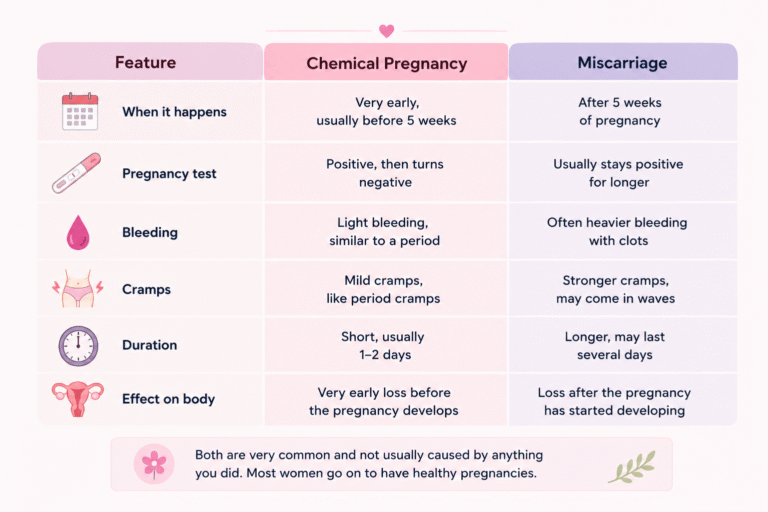
A chemical pregnancy is technically a very early type of miscarriage, but it’s talked about separately because of how early it happens and how different it feels.
Timing is the main difference. A chemical pregnancy happens before 5 weeks, right around the time your period would normally start. A “regular” miscarriage usually happens later, after 5 weeks, once a pregnancy has been confirmed on an ultrasound. According to the (ACOG), early pregnancy loss like this is more common than most people realize.
Confirmation is another difference. A chemical pregnancy is only confirmed through a positive pregnancy test and rising then falling hCG levels. There’s no ultrasound involved because it’s too early for anything to be visible. A later miscarriage, on the other hand, is usually confirmed through an ultrasound that shows a pregnancy sac, and sometimes a heartbeat, before the loss happens.
Physical experience also tends to differ. A chemical pregnancy often feels just like a slightly late or slightly heavier period, sometimes with a bit more cramping. A later miscarriage usually involves heavier bleeding, stronger cramping, and can take longer for your body to fully complete.
Medically, both are a form of early pregnancy loss, and neither means something is wrong with your ability to conceive in the future. But because a chemical pregnancy is so early and often unnoticed, it tends to feel less emotionally heavy for some women, while others still feel the loss deeply, even at this early stage, and that’s completely valid too.
Can a Positive Pregnancy Test Turn Negative?
Yes, this can happen, and it’s one of the more confusing parts of a chemical pregnancy. A test can show a clear positive result, and then a few days later, a repeat test comes back negative or much fainter.
This happens because of how pregnancy tests work. They detect the hormone hCG, which rises quickly in early pregnancy. If the pregnancy stops developing, hCG levels start dropping instead of rising. Once the level drops low enough, the test can no longer pick it up, so it shows negative even though it was positive just days before.
You might notice the test line getting fainter each day before it disappears completely, especially if you’re testing daily. Some women also notice their period starting around the same time the test turns negative, sometimes a few days late and slightly heavier or crampier than usual.
If this happens to you, it doesn’t mean the first test was wrong or a mistake. It usually means a chemical pregnancy occurred, and your body is simply completing the process on its own. If you’re testing again for reassurance, waiting 2 to 3 days between tests will give you a clearer picture, since a single day’s difference in hCG levels isn’t always a reliable sign either way. For more on the right timing and accuracy, see our guide on when to take a pregnancy test.
How Is a Chemical Pregnancy Diagnosed?
A chemical pregnancy isn’t usually “diagnosed” through a doctor’s visit, because it happens and ends so quickly, often before there’s even time to see anyone. Most of the time, it’s identified simply through home pregnancy tests.
The most common way it’s noticed is when a pregnancy test comes back positive, and then a follow-up test a few days later comes back negative or much fainter. This pattern, a positive test followed by bleeding that looks like a period, is usually enough for a chemical pregnancy to be suspected.
In some cases, especially for women going through fertility treatment or closely monitoring their cycle, a doctor may confirm it through blood tests that track hCG levels over a few days. If hCG rises at first and then drops instead of continuing to double every 48–72 hours as it normally would in a developing pregnancy, this pattern points to a chemical pregnancy.
An ultrasound isn’t useful for diagnosing a chemical pregnancy, since it happens too early for anything to be visible on a scan anyway. That’s really the key difference between this and a later pregnancy loss, there’s nothing to physically see, only hormone levels that rose and then came back down.
If this happens to you and you weren’t actively testing or tracking, you may never even know for certain it was a chemical pregnancy. It may have simply felt like a period that was a few days late.
Can You Have a Chemical Pregnancy After IVF?
Yes, a chemical pregnancy can occur after in vitro fertilization (IVF). Although IVF allows doctors to carefully select and transfer an embryo, implantation and early embryo development are still complex biological processes. A positive pregnancy test after an embryo transfer does not always mean that the pregnancy will continue to develop.
A chemical pregnancy after IVF occurs when an embryo implants in the uterus and produces hCG, but the pregnancy stops developing very early, usually before it can be confirmed by ultrasound. A blood pregnancy test may initially show a positive result, followed by falling hCG levels or a negative test.
Possible reasons include:
Chromosomal abnormalities in the embryo, which are a common cause of very early pregnancy loss.
Problems with embryo development or implantation.
Certain uterine or hormonal conditions that may affect early pregnancy.
Other factors affecting early pregnancy development, although the exact cause often cannot be identified after a single loss.
Importantly, experiencing a chemical pregnancy after IVF does not automatically mean that IVF will not work for you. Many people go on to have a successful pregnancy after an early loss. Your fertility specialist may review the embryo, transfer, hormone levels, uterine lining, and previous treatment history to decide whether any changes are needed before another transfer.
If chemical pregnancies or early pregnancy losses happen repeatedly after IVF, your fertility specialist may recommend additional evaluation to look for possible underlying factors.
If an IVF pregnancy continues beyond the early stages, you can use our [IVF Due Date Calculator] to estimate your expected due date based on your embryo transfer date.
Does a Chemical Pregnancy Affect Future Fertility?
No, a chemical pregnancy does not affect your future fertility or your chances of having a healthy pregnancy later on. This is one of the most reassuring things doctors want women to understand after going through this.
A chemical pregnancy is usually caused by a one-time chromosomal issue in that specific embryo, not by a problem with your body, your eggs, or your ability to carry a pregnancy. It’s not a sign of an underlying fertility issue, and it doesn’t damage your uterus or reproductive system in any way.
In fact, a chemical pregnancy can actually be seen as a positive sign in some ways. It shows that conception can happen, that an embryo was able to implant, and that your body responded with rising hCG, all of which are signs that your reproductive system is working as it should.
Most women who experience a chemical pregnancy go on to conceive again and have completely normal, healthy pregnancies afterward, often within just a few cycles. It’s only if chemical pregnancies happen repeatedly, several in a row, that it may be worth speaking to a doctor about further testing, since repeated early losses can sometimes point to an underlying cause worth investigating.
Coping After a Chemical Pregnancy
A chemical pregnancy can be emotionally difficult, even though it happens very early. You may feel sadness, disappointment, confusion, or even blame yourself for what happened. These feelings are completely understandable. A chemical pregnancy is usually caused by problems with the developing embryo, often related to chromosomal abnormalities, and it is not usually caused by something you did or did not do.
Give yourself time to process the loss. Talking with your partner, a trusted friend, or a healthcare professional can help. Everyone copes differently, so there is no “right” amount of time to grieve or recover emotionally.
Physically, bleeding after a chemical pregnancy may be similar to a heavier or later-than-usual period. Mild cramping can also occur. However, seek medical care if you experience very heavy bleeding, severe abdominal or pelvic pain, dizziness, fainting, fever, or other symptoms that concern you.
A chemical pregnancy does not usually mean that you will have difficulty becoming pregnant in the future. Many people go on to have healthy pregnancies after an early loss. If you have experienced repeated chemical pregnancies or multiple early pregnancy losses, your healthcare provider may recommend an evaluation to look for possible underlying causes.
Remember that experiencing a chemical pregnancy does not mean you cannot have a healthy pregnancy in the future. Be patient with yourself and give your body and emotions the time they need to recover.
When to See a Doctor
A chemical pregnancy often resolves on its own, but it is important to contact your healthcare provider if you have symptoms that are severe, unusual, or getting worse. Medical evaluation can help confirm that the pregnancy has ended and rule out other causes of bleeding or pain.
You should seek medical advice if you experience:
Very heavy bleeding, especially if you are soaking through pads quickly or the bleeding does not start to improve.
Severe or persistent abdominal or pelvic pain, particularly if the pain is stronger on one side.
Dizziness, fainting, weakness, or feeling unusually unwell.
Fever or chills, which may indicate an infection.
Foul-smelling vaginal discharge.
Bleeding or pain that continues longer than expected or does not gradually improve.
Repeated chemical pregnancies or early pregnancy losses. Your doctor may recommend further evaluation to determine whether there is an underlying issue.
It is also reasonable to speak with a healthcare professional if you are worried about your symptoms or simply want reassurance. If you have had a positive pregnancy test followed by bleeding or a negative test, your provider can determine whether any additional testing or follow-up is needed.
If you are experiencing severe pain, heavy bleeding, fainting, or other emergency symptoms, seek urgent medical care rather than waiting for a routine appointment.
Frequently Asked Questions
What is a chemical pregnancy?
A chemical pregnancy is a very early pregnancy loss that happens shortly after implantation, usually before 5 weeks of pregnancy. A pregnancy test may become positive because the body produces hCG, but the pregnancy stops developing before it can usually be seen on an ultrasound.
What are the common chemical pregnancy symptoms?
Common chemical pregnancy symptoms can include a positive pregnancy test followed by bleeding, menstrual-like cramps, or a negative pregnancy test a few days later. Some people may simply notice that their period arrives later or is heavier than usual.
Can a pregnancy test be positive and then negative?
Yes. A pregnancy test can initially be positive because hCG is present in the body, and then become negative as hCG levels fall after an early pregnancy loss. This pattern can occur with a chemical pregnancy.
What causes a chemical pregnancy?
Chemical pregnancy causes are not always possible to identify. In many cases, the pregnancy stops developing because of chromosomal abnormalities that occur during early development. It is usually not caused by something the person did or did not do.
Is a chemical pregnancy the same as a miscarriage?
A chemical pregnancy is considered a very early miscarriage. The main difference is that it happens so early that the pregnancy usually cannot be detected on an ultrasound. It may only be identified because a pregnancy test was positive.
How long does bleeding last after a chemical pregnancy?
Chemical pregnancy bleeding can vary from person to person. It may look similar to a normal period or be somewhat heavier, and it can be accompanied by mild cramps. If bleeding is very heavy, prolonged, or accompanied by severe pain, medical advice should be sought.
Does a chemical pregnancy affect future fertility?
In most cases, a chemical pregnancy does not affect future fertility. Having one early pregnancy loss does not usually mean that you will have difficulty becoming pregnant or carrying a pregnancy in the future.
How soon can you get pregnant after a chemical pregnancy?
Ovulation can return relatively soon after a chemical pregnancy, so pregnancy may be possible again during the following cycle. The right time to try again depends on your individual situation, physical recovery, and advice from your healthcare provider.
Can a chemical pregnancy be prevented?
Most chemical pregnancies cannot be prevented because they are often related to problems with early embryo development that are outside a person’s control. Maintaining general health and receiving appropriate prenatal care can support a healthy pregnancy, but cannot guarantee prevention of early pregnancy loss.
Do you need treatment after a chemical pregnancy?
A chemical pregnancy often resolves naturally without a procedure or specific treatment. However, a healthcare provider may recommend follow-up testing or evaluation depending on your symptoms, pregnancy history, or whether hCG levels remain elevated.
Can you have a healthy pregnancy after a chemical pregnancy?
Yes. Many people have a healthy pregnancy after experiencing a chemical pregnancy. One early loss does not usually indicate that future pregnancies will have the same outcome, and it does not mean that a healthy pregnancy is unlikely.