
What Happens During an IVF Cycle? A Step by Step Guide
An IVF cycle involves several steps, from preparing the ovaries and retrieving eggs to fertilizing them in a laboratory and transferring an embryo into the uterus. While the exact process can vary from person to person, most cycles follow a similar sequence. Understanding the IVF cycle step by step can make the process feel more manageable, especially if you are preparing for your first cycle.
This guide explains what happens during an IVF cycle step by step, including ovarian stimulation, egg retrieval, fertilization, embryo development, embryo transfer, and pregnancy testing.
What Is an IVF Cycle?
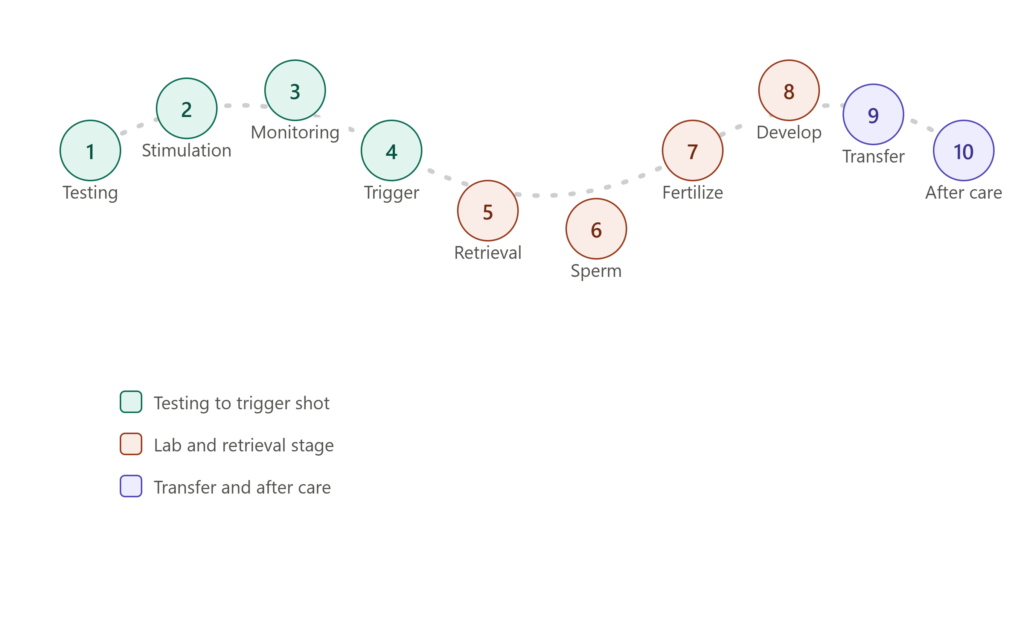
An IVF cycle is a series of medical steps used to help achieve pregnancy through in vitro fertilization (IVF). During the process, medications are used to stimulate the ovaries to develop multiple eggs. The eggs are then collected and fertilized with sperm in a laboratory to create embryos.
After the embryos develop for several days, a suitable embryo may be transferred into the uterus. If implantation occurs, pregnancy can be confirmed with a pregnancy test.
One IVF cycle generally includes ovarian stimulation, egg retrieval, fertilization, embryo development, and embryo transfer, although the exact treatment plan can differ depending on the individual and the fertility clinic.
The term “IVF cycle” can sometimes refer to the entire treatment process from starting medications through pregnancy testing, while some clinics may use it more specifically for the period of ovarian stimulation and egg retrieval.
VF is one of several fertility treatment options available to people who are having difficulty conceiving. You can learn more about the different approaches in our guide to Fertility Treatment: Types, Options, and What to Expect.
Step 1: Initial Fertility Testing and Treatment Planning
Before starting an IVF cycle, your fertility specialist will usually review your medical history and perform several tests to understand your reproductive health and decide which treatment approach is most appropriate.
For the woman, testing may include blood tests to check hormone levels, an ultrasound to assess the ovaries and uterus, and an assessment of ovarian reserve. These tests are generally straightforward, although some may require more than one appointment. Your doctor may also ask about your menstrual cycle, previous pregnancies, medications, and any previous fertility treatments.
The male partner may have a semen analysis to check sperm count, movement, and shape. Depending on the results, the fertility team may recommend standard IVF or a procedure such as intracytoplasmic sperm injection (ICSI).
During this stage, your doctor will also explain what each test is for and how the results may affect your treatment. It is normal to have questions or feel anxious, especially if this is your first fertility evaluation. Your clinic should explain what to expect and when you can expect your results.
Based on the test results, your doctor will create an individualized IVF treatment plan. This may include deciding which medications to use, when ovarian stimulation should begin, how the ovaries will be monitored, and whether a fresh or frozen embryo transfer is planned.
Once the treatment plan is ready, you can move on to the next stage: ovarian stimulation, where fertility medications are used to encourage the ovaries to develop multiple eggs.
Step 2: Ovarian Stimulation
Once your IVF treatment plan is ready, the next stage is ovarian stimulation. During this part of the IVF cycle, fertility medications are used to encourage the ovaries to develop multiple mature eggs instead of the single egg that usually develops during a natural menstrual cycle.
Your fertility specialist will prescribe the medications and explain when and how to take them. These medications are commonly given as injections over several days. The exact medicines, doses, and length of treatment can vary depending on your age, ovarian reserve, previous IVF response, and individual treatment plan.
The goal of ovarian stimulation is to produce several healthy eggs that can be collected during egg retrieval. Having multiple eggs gives the fertility team more opportunities for fertilization and embryo development, although not every egg will necessarily result in an embryo.
During stimulation, you may notice temporary side effects such as bloating, breast tenderness, mood changes, fatigue, or mild discomfort around the ovaries. Your clinic will monitor your response closely and may adjust your medication dose if needed.
The stimulation stage usually lasts around 8 to 14 days, but the timing can vary from person to person. Once the follicles have developed sufficiently, you will move to the next stage of the IVF process: monitoring follicle growth and hormone levels.
Step 3: Monitoring Follicle Growth
During ovarian stimulation, your fertility clinic will monitor how your ovaries are responding to the medications. The main goal is to track the growth of the follicles, which are small fluid-filled sacs in the ovaries where eggs develop.
Monitoring usually involves transvaginal ultrasounds and blood tests. The ultrasound allows your doctor to measure the size and number of developing follicles, while blood tests may check hormone levels such as estrogen. These checks help your fertility team determine whether your ovaries are responding as expected.
You may need several monitoring appointments during this stage because follicles do not all grow at exactly the same rate. Based on your results, your doctor may adjust your medication dose or continue treatment for a few more days.
Once the follicles reach an appropriate size and your hormone levels are suitable, your doctor will decide when you are ready for the trigger shot. This injection helps the eggs complete their final stage of maturation before egg retrieval.
The timing of the trigger shot is important because egg retrieval is usually scheduled about 34 to 36 hours afterward. Your clinic will give you specific instructions about when to take the injection and when to arrive for the retrieval procedure.
Step 4: The Trigger Shot
Once the follicles have developed enough during ovarian stimulation, your fertility specialist will give you a trigger shot to help the eggs complete their final stage of maturation. This injection is an important part of the IVF cycle because it helps the medical team carefully time the egg retrieval.
The trigger shot usually contains human chorionic gonadotropin (hCG) or, in some treatment plans, a medication known as a GnRH agonist. Your doctor will choose the type based on your individual treatment plan and how your ovaries have responded to stimulation.
Timing is especially important. Egg retrieval is generally scheduled about 34 to 36 hours after the trigger shot, before ovulation would normally occur. Your clinic will give you an exact time to take the injection and will tell you when to arrive for your egg retrieval.
You may experience mild symptoms after the trigger shot, such as bloating, breast tenderness, headache, or mild abdominal discomfort. Your fertility team will also explain which symptoms are expected and when you should contact them if you develop more concerning symptoms.
After the trigger shot, the next step is egg retrieval, where the mature eggs are collected from the ovaries for fertilization in the laboratory.
Step 5: Egg Retrieval
Egg retrieval is the procedure used to collect mature eggs from the ovaries after ovarian stimulation. It is usually performed at a fertility clinic and is timed carefully after the trigger shot.
During the procedure, the doctor uses a transvaginal ultrasound to guide a thin needle through the vaginal wall and into the ovaries. The needle is used to gently collect fluid from the follicles, which contains the eggs. The procedure usually takes around 15 to 30 minutes, although the exact time can vary.
You will typically receive sedation or pain medication to help you stay comfortable during egg retrieval. Afterward, you may have mild cramping, bloating, or light vaginal spotting for a short time. Most people can go home the same day, although you will usually need someone to drive you home if you received sedation.
The number of eggs retrieved can vary widely from one person to another. Not every egg collected will be mature, and only mature eggs can normally be fertilized. The collected eggs are immediately taken to the laboratory, where they can be fertilized with sperm.
After egg retrieval, the IVF process moves to the next stage: sperm collection and fertilization.
Step 6: Sperm Collection
Sperm collection is usually done on the same day as egg retrieval, although the timing can vary depending on the treatment plan. The sperm sample is typically provided by the male partner at the fertility clinic or collected at home if the clinic allows it.
Before providing the sample, the clinic may recommend avoiding ejaculation for a specific period of time. This can help the laboratory obtain a suitable sample for fertilization. The clinic will provide instructions based on its own procedures and your individual circumstances.
After collection, the laboratory analyzes the sperm for factors such as sperm count, movement (motility), and shape (morphology). The sample is then prepared so that the healthiest sperm can be used for fertilization.
If there are significant sperm-related concerns, the fertility specialist may recommend intracytoplasmic sperm injection (ICSI). With ICSI, a single sperm is injected directly into a mature egg to help achieve fertilization.
Once the eggs and sperm are prepared, they are taken to the laboratory for the next stage of the IVF process: fertilization.
Step 7: Fertilization in the Laboratory
After egg retrieval, the mature eggs are taken to the fertility laboratory, where they are combined with sperm to allow fertilization to occur. The goal is to create embryos that can continue developing over the next several days.
There are two main ways fertilization may be performed during IVF. With conventional IVF, the eggs and prepared sperm are placed together in a laboratory dish and allowed to fertilize naturally. With intracytoplasmic sperm injection (ICSI), a single sperm is injected directly into a mature egg. Your fertility specialist will recommend the approach based on factors such as sperm quality, previous IVF results, and your individual treatment plan.
The laboratory team checks the eggs after fertilization to see which ones have successfully fertilized. Not every mature egg will fertilize, so the number of resulting embryos may be lower than the number of eggs originally collected.
Successfully fertilized eggs then begin dividing and developing into embryos. They are carefully monitored in the laboratory over the following days before the fertility team decides which embryo or embryos may be suitable for transfer.
The next stage is embryo development, when the fertilized eggs continue growing and are assessed before embryo transfer.
Step 8: Embryo Development
After successful fertilization, the fertilized eggs continue to develop in the laboratory. During this stage, the embryos are kept under carefully controlled conditions while embryologists monitor their growth and development.
In the first few days, the fertilized egg begins dividing into more cells. By around day 3, an embryo may have several cells, and by day 5 or 6, some embryos develop into a blastocyst. Not every fertilized egg will continue developing to the blastocyst stage, so the number of embryos available for transfer may be lower than the number of eggs retrieved.
The embryology team evaluates the embryos based on their development and appearance to determine which may have the best potential for implantation. In some cases, embryo genetic testing (PGT) may also be considered before transfer, depending on the couple’s circumstances and the clinic’s recommendations.
At this point, the fertility team will decide whether an embryo is ready for transfer and whether the transfer will be performed during the same IVF cycle or at a later time using a frozen embryo transfer.
Once an embryo is selected for transfer, the next step is embryo transfer, when the embryo is placed into the uterus.
Step 9: Fresh or Frozen Embryo Transfer
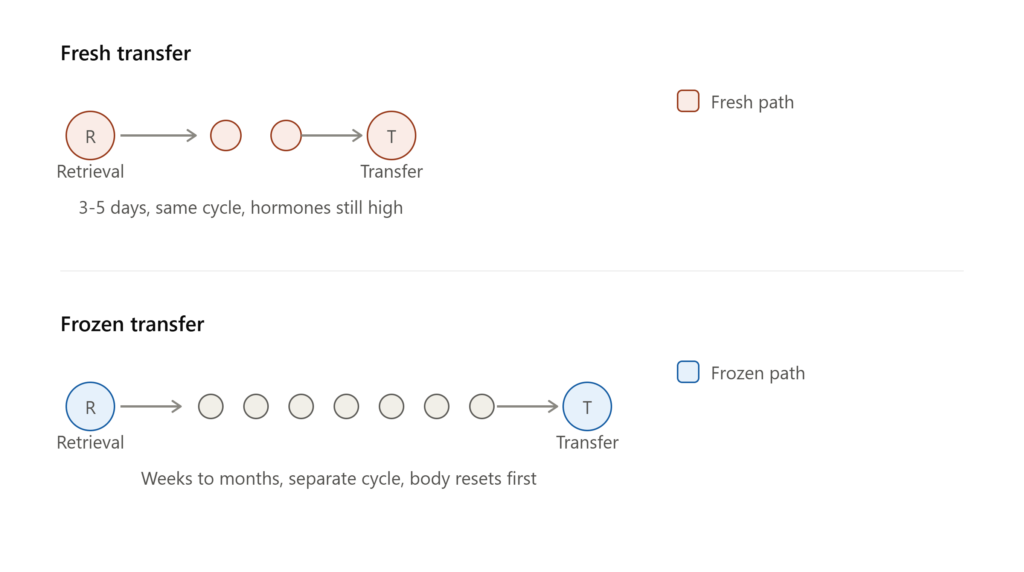
Embryo transfer is the stage of IVF when a selected embryo is placed into the uterus with the goal of achieving implantation and pregnancy. Depending on your treatment plan, the transfer may be done during the same IVF cycle as egg retrieval (fresh embryo transfer) or during a later cycle using a previously frozen embryo (frozen embryo transfer).
A fresh embryo transfer usually takes place a few days after egg retrieval, once the embryo has developed sufficiently. With a frozen embryo transfer, the embryo is thawed and transferred when the uterine lining is prepared for implantation. Your fertility specialist will recommend the timing based on your individual treatment plan.
During the procedure, a thin, flexible catheter is gently passed through the cervix into the uterus. The selected embryo is then released into the uterine cavity. Embryo transfer is generally a quick procedure and usually does not require anesthesia, although you may experience mild cramping or pressure.
After the transfer, the embryo needs to implant into the uterine lining for pregnancy to occur. Our [Implantation Calculator] can help you estimate when implantation may occur based on your embryo transfer timing.
Your fertility clinic will also tell you when to take a pregnancy test. If the test is positive, you can use our IVF Due Date Calculator to estimate your pregnancy due date based on your IVF treatment and embryo transfer date.
The next stage is understanding what happens after embryo transfer, including implantation, possible symptoms, medications, and the waiting period before your pregnancy test.
Step 10: What Happens After Embryo Transfer?
After an embryo transfer, the embryo needs to implant into the uterine lining before pregnancy can occur. This waiting period is often called the IVF two-week wait, although the exact timing of the pregnancy test can vary depending on your clinic and the type of embryo transfer.
You can usually return to your normal daily activities after the procedure unless your fertility clinic gives you different instructions. Mild cramping, bloating, or light spotting can occur after embryo transfer and does not necessarily mean that the treatment has failed or succeeded. Some people have no noticeable symptoms at all.
You will usually continue any prescribed medications, such as progesterone, according to your clinic’s instructions. It is important not to stop prescribed medication simply because you experience bleeding or do not have pregnancy symptoms unless your fertility team tells you to do so.
During this time, the embryo may implant into the uterine lining. However, implantation symptoms are not a reliable way to know whether IVF has been successful, as many people experience no symptoms during this stage.
Your fertility clinic will give you a specific date for your pregnancy test after IVF. Testing too early can sometimes give misleading results, particularly if an hCG-containing trigger shot was used during the cycle. A blood pregnancy test is often used by fertility clinics to confirm the result.
If the pregnancy test is positive, your clinic may arrange follow-up blood tests and an early ultrasound to monitor the pregnancy. If the test is negative, your fertility specialist can discuss the result with you and explain what options may be available for a future cycle.
When Do You Take a Pregnancy Test After IVF?
A pregnancy test after IVF is usually taken about 9 to 14 days after embryo transfer, depending on the type of embryo transferred and your fertility clinic’s protocol. Your clinic will give you a specific testing date based on your treatment.
A blood test is often preferred because it can detect human chorionic gonadotropin (hCG) more accurately than an early home pregnancy test. Testing too soon may give an unclear or misleading result because hCG levels may still be too low to detect.
If you used an hCG trigger shot during your IVF cycle, testing very early can also produce a false-positive result because the medication can remain in your body for a short time. For this reason, it is best to follow the testing date provided by your fertility clinic rather than testing immediately after embryo transfer.
A positive pregnancy test means that hCG has been detected, but your fertility clinic may repeat the blood test to see whether hCG is rising appropriately. If the result is negative, your doctor can discuss what the result means and whether another IVF cycle or a different treatment approach may be appropriate.
The waiting period between embryo transfer and pregnancy testing can feel stressful, but not having pregnancy symptoms does not necessarily mean IVF has been unsuccessful. Many people have few or no noticeable symptoms before their pregnancy test.
How Long Does an IVF Cycle Take?
The length of an IVF cycle can vary from person to person, but the active treatment process often takes around 2 to 4 weeks. The exact timeline depends on the treatment protocol, how your ovaries respond to medication, and whether you have a fresh or frozen embryo transfer.
The ovarian stimulation stage usually takes about 8 to 14 days, followed by the trigger shot and egg retrieval approximately 34 to 36 hours later. After egg retrieval, fertilization and embryo development take several more days before an embryo is ready for transfer.
With a fresh embryo transfer, the transfer may take place a few days after egg retrieval. With a frozen embryo transfer, the transfer happens during a later cycle after the uterine lining has been prepared, so the overall treatment timeline can be longer.
After embryo transfer, you will need to wait before taking a pregnancy test. Your fertility clinic will give you a specific testing date based on your treatment and embryo transfer.
Because IVF treatment is individualized, your personal timeline may be shorter or longer than the typical range. Your fertility specialist can give you a more accurate estimate based on your treatment plan and response to the medications.
What Can Affect the IVF Process?
Several factors can affect how an IVF cycle progresses and how many eggs or embryos are available for transfer. Your fertility specialist considers these factors when creating and adjusting your treatment plan.
Age is one of the most important factors because egg number and egg quality generally decline with age. Ovarian reserve can also affect how the ovaries respond to stimulation and how many eggs may be retrieved.
Sperm quality can influence fertilization and embryo development. Factors such as sperm count, movement, and shape may affect which fertilization method is recommended.
Your response to fertility medications can also vary. Some people produce many follicles during ovarian stimulation, while others may produce fewer. The doctor may adjust medication doses based on ultrasound and hormone monitoring.
Other factors may include uterine health, previous IVF results, underlying fertility conditions, embryo quality, and the timing of embryo transfer. Overall health and certain lifestyle factors may also play a role in fertility treatment.
Because every IVF cycle is different, there is no single timeline or outcome that applies to everyone. Your fertility team will monitor your progress throughout treatment and make adjustments when needed to give the cycle the best possible chance of success.
What Happens If IVF Does Not Work?
Not every IVF cycle results in pregnancy, and a negative result does not necessarily mean that IVF will never work. If the pregnancy test is negative, your fertility specialist will usually review the cycle with you to understand how your body responded to treatment and whether anything should be changed before trying again.
Your doctor may review factors such as the number and quality of eggs retrieved, fertilization results, embryo development, and how the uterine lining responded. Depending on your individual situation, additional testing or a change in the IVF protocol may be recommended.
If you have frozen embryos remaining from the cycle, your doctor may discuss a frozen embryo transfer rather than starting another full stimulation cycle. If no suitable embryos remain, another IVF cycle may be considered.
The number of IVF cycles needed varies widely. Some people become pregnant after their first attempt, while others may need more than one cycle. Your age, ovarian reserve, sperm quality, embryo development, and the underlying cause of infertility can all influence the chances of success.
It can be emotionally difficult when IVF does not work, so it is important to give yourself time to process the result. Your fertility specialist can help you understand what happened and discuss the options that may be appropriate for your next step.
Frequently Asked Questions
How many days does an IVF cycle take?
An active IVF cycle usually takes around 2 to 4 weeks, although the exact timeline varies from person to person. Ovarian stimulation often lasts about 8 to 14 days, followed by the trigger shot, egg retrieval, fertilization, embryo development, and embryo transfer. If a frozen embryo transfer is planned, the overall process may take longer.
Is IVF egg retrieval painful?
Egg retrieval is usually performed with sedation or pain medication, so most people do not feel significant pain during the procedure. You may experience mild cramping, bloating, or light spotting afterward. These symptoms are generally temporary, but your fertility clinic will give you instructions about when to contact them if you develop severe or unusual symptoms.
How many eggs are usually retrieved during IVF?
The number of eggs retrieved during IVF varies depending on factors such as age, ovarian reserve, and response to fertility medications. Some people may have only a few eggs retrieved, while others may have more. Not every retrieved egg will be mature or successfully fertilize, so the number of eggs does not directly equal the number of embryos available for transfer.
How long after egg retrieval is embryo transfer?
Many people are able to continue working during an IVF cycle, particularly during the early stages of treatment. However, frequent monitoring appointments, medication side effects, and the egg retrieval procedure may require some flexibility. Jobs involving heavy physical activity or strenuous work may require additional precautions, so follow your fertility clinic’s advice.
Can you work during an IVF cycle?
Many people are able to continue working during an IVF cycle, particularly during the early stages of treatment. However, frequent monitoring appointments, medication side effects, and the egg retrieval procedure may require some flexibility. Jobs involving heavy physical activity or strenuous work may require additional precautions, so follow your fertility clinic’s advice.
What happens if no embryos develop?
If no embryos develop to a stage suitable for transfer, your fertility specialist will usually review the cycle to understand what may have contributed to the outcome. Factors such as egg quality, sperm quality, fertilization, and embryo development may be considered. Your doctor may recommend adjustments, additional testing, or a different approach before another IVF attempt.
When can you find out if IVF worked?
You can usually find out whether IVF worked when you take a pregnancy test after embryo transfer, often around 9 to 14 days after the transfer depending on your treatment. Fertility clinics commonly use a blood test to check for hCG because it can detect pregnancy more reliably than testing very early with a home test. Your clinic will give you the specific date to test.