
Ovulation Calculator & Calendar
Track your ovulation days and fertile window with ease
Next Period
-
Ovulation Day
-
Fertile Window
-
Cycle Length
-
Lower-Fertility Days
-
Estimate Confidence
Basic Estimate
Note: This calculator provides estimates based on the information entered. Ovulation can vary between cycles. For medical advice or concerns about fertility or contraception, consult a qualified healthcare professional.
Track Your Fertile Days Accurately With an Ovulation Predictor
Understanding your fertile window can make planning a pregnancy much easier. Tools like an ovulation predictor help you estimate the days when your chances of conceiving are highest. Whether your cycle is regular, irregular, or you are recovering from a miscarriage, tracking ovulation gives valuable insight into your reproductive health.
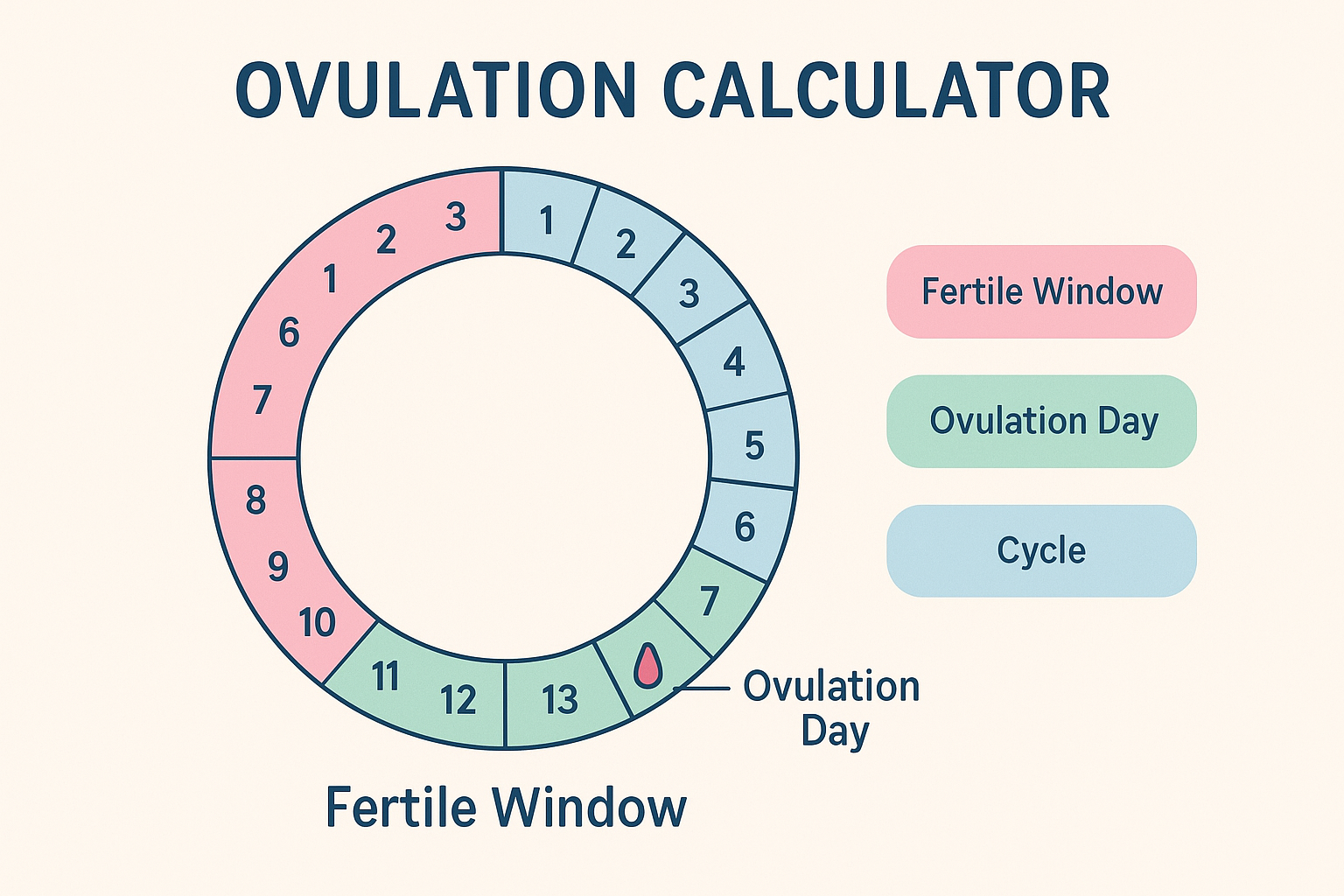
Ovulation and Fertility Tracking Chart
A fertility chart or tracker highlights:
Your fertile days
Likely ovulation date
Cycle patterns for better pregnancy planning
Visual tools help you see at a glance when conception is most likely.
What Is an Ovulation Calculator?
An ovulation calculator predicts when ovulation—your egg release—is likely to occur during your menstrual cycle. Since ovulation usually happens about 14 days before your next period, knowing this window can help identify your fertile days. During these few days, your chances of conception are highest.
Most online ovulation calculators, similar to methods described by the [Mayo Clinic] ,use your cycle length, last period date, and luteal phase duration to calculate your estimated ovulation date and fertility window.. This tool is especially helpful if you want to plan conception with greater precision and track your fertile days accurately.
How It Works
Most tools calculate ovulation based on your last menstrual period (LMP) and your average cycle length. For example:
If you have a 28-day cycle, ovulation usually occurs on day 14.
If you have a 35-day cycle, it likely happens around day 21.
The calculator then identifies your fertile window—the five days before and including your ovulation day.
You can try our Ovulation and [Implantation Calculator] to estimate both your fertile days and when implantation may occur if conception takes place. Not sure if what you’re feeling is implantation or your period? Our [Implantation Vs Period Calculator] can help you tell the difference. Once you conceive, try our [Due Date Calculator] to estimate when your baby will arrive based on your ovulation or conception date.
Tracking Ovulation With Irregular Periods
Irregular periods make it harder to predict ovulation, since the usual math (counting 14 days before your next period) doesn’t work well when your cycle length keeps changing. An irregular cycle ovulation tool can still help, but it works best when it looks at your last 3 to 6 cycles instead of just one, so it can find your average pattern rather than guessing from a single month.
To get a more reliable estimate with irregular periods, try combining the calculator with:
- Basal body temperature (BBT) tracking, which shows a small rise after ovulation has already happened
- Cervical mucus changes, since it usually becomes clear and stretchy right before ovulation, even when cycle length varies
- Ovulation predictor kits (OPK), which detect the LH hormone surge that happens 24–36 hours before ovulation
Common causes of irregular cycles include PCOS, thyroid issues, high stress, sudden weight changes, or coming off birth control. If your cycles are irregular because of one of these reasons, tracking symptoms alongside the calculator gives a much clearer picture than dates alone.
If your cycles stay unpredictable for several months in a row, or if you’re trying to conceive without success, it’s a good idea to speak with your doctor. They can check if an underlying condition is affecting ovulation.
Ovulation After Miscarriage
After a miscarriage, your body needs some time for hormone levels to settle back down before ovulation can happen again. For most women, ovulation returns within 2 to 4 weeks, sometimes even before your first period comes back. This means it’s possible to conceive again before you’ve had a period, which is why it’s important to know when your body is ready.
How quickly ovulation returns can depend on a few things:
- How far along the pregnancy was — an earlier miscarriage usually means a quicker return to normal cycles, while a later one may take longer
- Whether a D&C procedure was needed, which can sometimes delay the first period slightly
- Individual hormone levels, since every woman’s body recovers at a different pace
An ovulation after miscarriage calculator can help estimate when your fertile days might return, based on the date of your miscarriage and your usual cycle length before pregnancy. Since your first cycle afterward can be shorter, longer, or a bit irregular, it’s best to track it closely rather than assume it will match your old pattern exactly.
Every woman’s recovery is different, both physically and emotionally. Before trying to conceive again, it’s a good idea to talk to your doctor to make sure your body and you are ready.
Ovulation After Birth Control or Abortion
Stopping birth control pills doesn’t always mean ovulation starts right away. For most women, it returns within 1 to 3 months, but for some it can take a little longer, especially if periods were irregular before starting birth control. Other methods work differently too. With an IUD or the implant, ovulation often comes back within a few weeks, since these don’t stop ovulation the same way pills do. The birth control shot (Depo-Provera) usually takes the longest, sometimes up to 6 to 10 months before ovulation returns to normal.
After an abortion, ovulation can return even faster, sometimes as early as 2 to 4 weeks later, even before your first period comes back. This means it’s possible to become pregnant again before you’ve had a period, which is why many doctors recommend using protection if you’re not trying to conceive right away.
Because the first cycle or two after stopping birth control or after an abortion can be shorter, longer, or irregular, it’s best to track at least two full cycles before relying on a calculator for accurate predictions.
If your periods don’t return within 3 months, or if something feels off, it’s worth checking in with your doctor to make sure everything is on track.
Ovulation Calculator for Twins and Gender Prediction
Many couples wonder if an ovulation calculator can help predict twins or choose their baby’s gender. While no calculator can guarantee either, timing around ovulation does play a role in some theories.
Gender Prediction (Shettles Method)
This theory is based on the idea that sperm carrying a Y chromosome (boy) swim faster but don’t live as long, while sperm carrying an X chromosome (girl) are slower but survive longer in the body.
- For a boy: intercourse closer to ovulation, ideally on the day of or the day before
- For a girl: intercourse 2–3 days before ovulation, then avoiding intercourse closer to ovulation day
It’s important to know this method is not scientifically proven, and most fertility doctors don’t consider it a reliable way to choose gender. It’s more of a traditional theory some couples try, not a guaranteed method.
Twins
An ovulation calculator for twins can’t predict twins on its own, but a few factors are known to slightly raise the chances:
- Hyperovulation, when the ovaries release two eggs in the same cycle instead of one
- Fertility medications like Clomid or Letrozole, which are known to increase the chance of releasing more than one egg
- Family history of twins, especially on the mother’s side, since hyperovulation can run in families
- Being over 30, since hormone changes with age can sometimes lead to releasing more than one egg
If twins run in your family or you’re using fertility medication, it’s worth mentioning this to your doctor, since they can monitor your cycle more closely if needed.
Remember, an ovulation calculator is a helpful guide for timing, but it can’t control or guarantee outcomes like gender or twins — those depend on biology, not timing alone.
Ovulation and Implantation Timeline
After ovulation, if an egg is fertilized, implantation usually happens 6–10 days later. Using an ovulation and implantation calculator helps estimate:
When ovulation occurs.
When implantation might take place.
The earliest date you can take a pregnancy test.
For example:
If ovulation occurs on November 10, implantation may happen between November 16–20.
You could take an early pregnancy test about 10–12 days after ovulation.
Ovulation for PCOS or Fertility Medication Users
Women with Polycystic Ovary Syndrome (PCOS) often have cycles that are hard to predict. This is because PCOS changes hormone levels, which can delay ovulation, make it happen at different times each month, or sometimes stop it from happening at all. A PCOS ovulation calculator works better when it’s used together with other tracking methods, not on its own.
To get better results with PCOS, try combining the calculator with:
- Ovulation predictor kits (OPK), though results can be less clear because PCOS often causes naturally higher LH levels
- Basal body temperature (BBT) tracking, which confirms ovulation after it has already happened
- Cervical mucus changes, since fertile mucus still shows up close to ovulation even with irregular cycles
If you’re taking fertility medication like Clomid or Letrozole, ovulation usually happens 5 to 10 days after your last dose, most often around days 5–9 after a standard 5-day course. Since these medications help trigger ovulation on a set schedule, it’s often more accurate to count from your last pill date instead of your last period date.
If your cycles stay very irregular even with tracking, it’s a good idea to talk to your doctor or a fertility specialist. They may suggest blood tests or an ultrasound to check ovulation more precisely.
Get Weekly Pregnancy & Fertility Tips
Get helpful, evidence-based insights on implantation, early pregnancy, fertility, ovulation, and pregnancy testing, delivered straight to your inbox every week.
Frequently Asked Questions
What is the most accurate ovulation calculator?
The most accurate ovulation calculator is the one that uses your average cycle length and last period date. Combining it with physical signs like cervical mucus and basal body temperature makes results more precise.
How to calculate ovulation if I have irregular periods?
If your periods are irregular, track your cycle for a few months and use an ovulation calculator that adjusts for variable lengths. Ovulation usually occurs about 14 days before your next period.
Can I use an ovulation calculator after a miscarriage?
Yes, once your cycles return to normal, you can use an ovulation calculator to estimate fertile days. However, wait until your doctor confirms it’s safe to try again.
Can an ovulation calculator predict baby gender?
Some people use timing theories to influence gender, but ovulation calculators can’t guarantee a baby’s gender—they only help identify your fertile window.
How reliable is an ovulation calculator when I have irregular cycle lengths?
Ovulation calculators are less reliable for women with highly irregular cycles. It’s best to track additional ovulation symptoms or use ovulation test kits for better accuracy.
How long does the fertile window last after ovulation?
The fertile window usually lasts about 6 days—five days before ovulation and the day of ovulation itself.
Does PCOS affect the accuracy of an ovulation calculator?
With PCOS, ovulation timing shifts frequently, which can make calculator predictions less accurate. Combining it with cervical mucus tracking or ovulation test kits gives better results.
How does an Ovulation Predictor Kit (OPK) help?
An OPK detects the LH hormone surge in urine. A positive result usually means ovulation will occur within 24–36 hours, which helps confirm and refine the calculator’s estimate.
Does perimenopause affect calculator accuracy?
Yes. During perimenopause, hormone levels fluctuate unpredictably and cycles become irregular, which makes calculator estimates less reliable. Tracking symptoms becomes more useful than relying on date-based prediction alone.