
Conception Date Calculator
Wondering when you conceived? Our Conception Date Calculator helps estimate your conception date based on your estimated due date or the first day of your last menstrual period (LMP). It also provides an estimated fertile window, pregnancy age, and estimated due date.
Enter the date information you know to get an estimated conception date. Because ovulation and conception timing can vary from one person to another, the result is an estimate rather than an exact date.
Estimated Conception Date
-
Fertility Window
-
Pregnancy
-
Estimated Due Date
-
This calculator provides an estimate based on standard pregnancy dating. Actual conception and pregnancy timing can vary from person to person.
How Does a Conception Date Calculator Work?
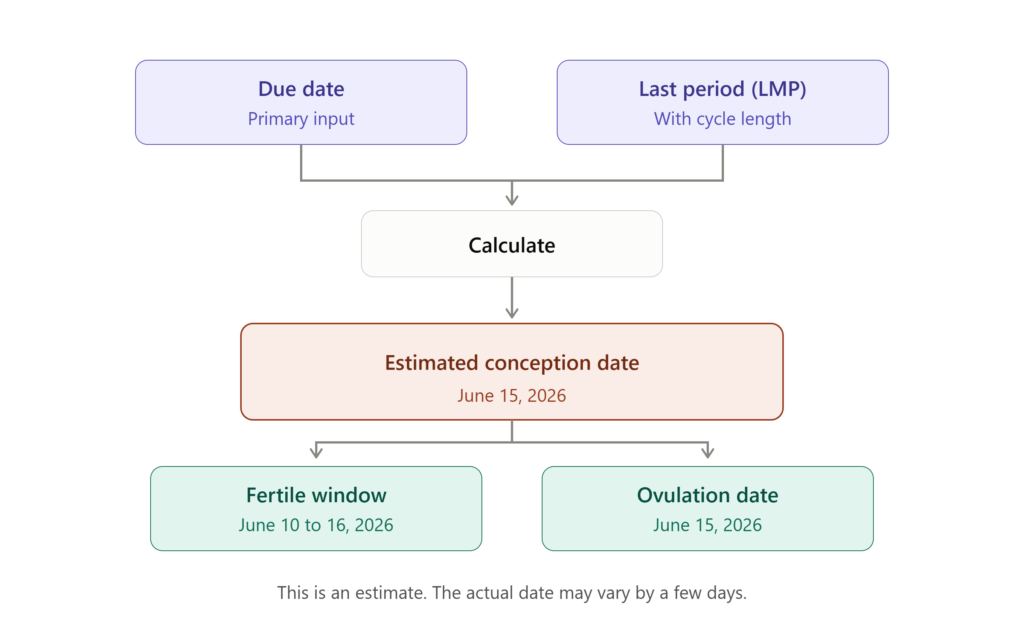
A conception date calculator estimates when fertilization may have occurred based on pregnancy dating information. In a typical pregnancy, conception happens around the time of ovulation, approximately two weeks after the first day of the last menstrual period for someone with a 28-day cycle.
When an estimated due date is known, the estimated conception date can be calculated by counting back about 266 days. When the last menstrual period is known, conception is commonly estimated around 14 days after the first day of the period.
These calculations provide an approximate date because ovulation does not always happen on the same day in every menstrual cycle.
If your pregnancy resulted from IVF, our IVF Due Date Calculator can help estimate your pregnancy due date based on your IVF treatment dates.
What Information Do You Need to Calculate Your Conception Date?
Due Date
If you know your estimated due date, the calculator can estimate your conception date by counting backward from the expected delivery date.
Last Period Date (LMP)
The first day of your last menstrual period can be used to estimate ovulation, conception, and the expected due date using standard pregnancy dating.
Ultrasound Date
An ultrasound date can be useful as a reference date for estimating how far along a pregnancy is. However, the ultrasound date alone does not determine the exact conception date.
What Is the Fertile Window?
The fertile window is the period when pregnancy is most likely to occur around ovulation. It generally includes the several days leading up to ovulation and a short period after ovulation.
Sperm can survive for several days in the reproductive tract, while an egg can usually be fertilized for a relatively short time after ovulation. This is why conception may occur from intercourse that happens before the actual day of ovulation.
You can also use our Ovulation Calculator to estimate when ovulation may occur and identify your most fertile days.
Can You Know the Exact Conception Date?
Usually, the exact date of conception cannot be known with certainty. Ovulation can occur earlier or later than expected, and fertilization may happen within a short period after ovulation.
A conception date calculator provides an estimated date based on available pregnancy dating information. It should be viewed as an approximate date rather than proof of the exact day conception occurred.
What Is the Difference Between Conception Date and Due Date?
Conception date is the estimated time when fertilization occurred.
Due date is the estimated date when the pregnancy reaches about 40 weeks from the first day of the last menstrual period.
Pregnancy dating is generally calculated from the LMP rather than from the actual day of conception, which is why the pregnancy is usually considered about two weeks further along than the time since conception.
If you want to calculate your estimated delivery date, you can also use our Due Date Calculator.
Conception Date Calculator Example
For example: If your estimated due date is known, the calculator can count back approximately 266 days to estimate when conception may have occurred.
If you enter your LMP instead, the calculator uses standard pregnancy dating to estimate the conception date and due date.
How Accurate Is a Conception Date Calculator?
A conception date calculator can provide a useful estimate, but it cannot determine the exact day conception occurred. The calculation is based on standard pregnancy dating, which assumes typical ovulation timing.
Your actual conception date may differ by several days depending on when ovulation and fertilization occurred. Early pregnancy ultrasound dating may also provide a more reliable estimate of pregnancy age when the dates are uncertain.
For more detailed information about pregnancy dating and estimating your due date, visit the American College of Obstetricians and Gynecologists (ACOG).
Frequently Asked Questions
How do I calculate my conception date?
You can estimate your conception date by using your estimated due date or the first day of your last menstrual period. A standard calculation estimates conception at about 266 days before the due date or around 14 days after the LMP in a typical 28-day cycle.
Can I calculate conception date from my due date?
Yes. An estimated conception date can be calculated by counting approximately 266 days backward from the estimated due date. This provides an approximate date because the actual timing of ovulation and fertilization can vary.
How many days after my period do I conceive?
For a typical 28-day menstrual cycle, ovulation may occur around 14 days after the first day of the period, and conception can occur around this time. However, ovulation timing varies between people and between cycles.
Can an ultrasound tell me my exact conception date?
No. An ultrasound can help estimate pregnancy age and dating, but it usually cannot identify the exact day fertilization occurred.
Does the conception date calculator work with an irregular cycle?
A basic conception date calculator may be less accurate when ovulation occurs earlier or later than expected. Irregular cycles can make LMP-based calculations less reliable.
Is conception date the same as ovulation date?
Not necessarily. Conception usually occurs when sperm fertilizes an egg around the time of ovulation. Because sperm can survive for several days, intercourse may happen before ovulation while fertilization occurs later.
Why is my calculated conception date different from the date I had sex?
Can I use my LMP to estimate when I conceived?
Yes. The first day of your last menstrual period can be used to estimate ovulation and conception using standard pregnancy dating. The result is an estimate rather than an exact conception date.