
Ovulation Calculator for Boy: What the Science Says
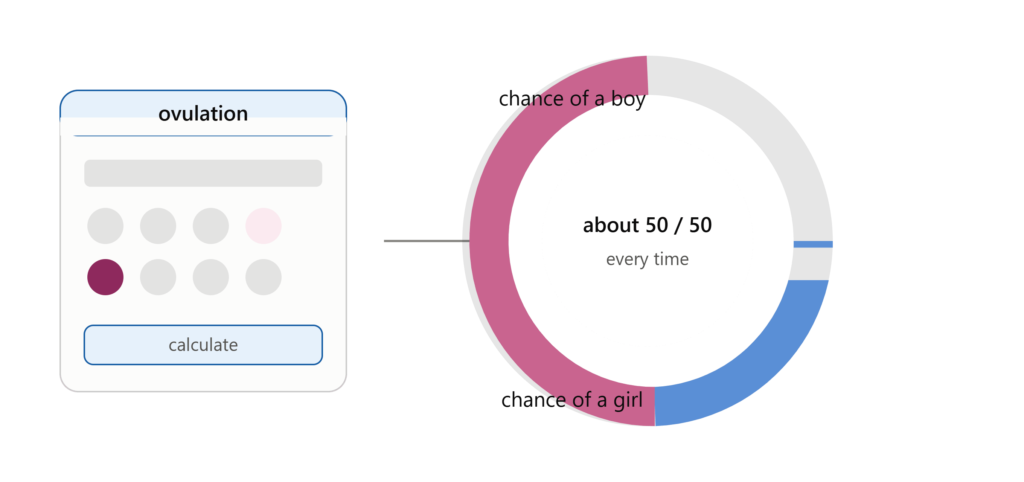
If you’re trying to conceive a boy, you may have heard that having sex close to ovulation can increase your chances. This idea is often linked to the Shettles method, which suggests that timing intercourse around ovulation may favor conception with a boy.
However, scientific research has not confirmed that timing intercourse around ovulation can reliably determine or increase the chances of having a boy. An ovulation calculator can help estimate when ovulation may occur, but it cannot predict your baby’s sex.
You can use our Ovulation Calculator to estimate your fertile window and understand when you are most likely to ovulate. If you’re trying to conceive, this can help you identify the days when pregnancy is most likely.
So, while an ovulation calculator can be useful for timing conception, it should not be considered a proven method for conceiving a boy.
Is There an Ovulation Calculator for a Boy?
There is no scientifically proven ovulation calculator that can tell you which days are more likely to result in a baby boy. Ovulation calculators estimate when ovulation is likely to occur based on information about your menstrual cycle, but they cannot determine whether a pregnancy will result in a boy or a girl.
You may come across claims that having sex very close to ovulation can increase the chances of conceiving a boy. This idea is based on the theory that Y-carrying sperm may reach the egg faster. However, research has not found reliable evidence that timing intercourse around ovulation can determine a baby’s sex.
So, if you see an “ovulation calculator for boy,” it is essentially using a regular ovulation estimate together with a baby-sex selection theory. It should not be presented as a guaranteed or scientifically proven way to conceive a boy.
Pampers notes that the sex of a baby is decided at conception by chance, since which sperm, X or Y, reaches the egg first cannot be reliably influenced.
What Is the Shettles Method?
The Shettles method is a theory from the 1970s about choosing a baby’s sex through the timing of sex. Dr. Landrum Shettles, who created it, believed that:
- Sperm carrying a Y chromosome (which lead to a boy) swim faster, but do not survive as long inside the body.
- Sperm carrying an X chromosome (which lead to a girl) swim slower, but survive longer.
Based on this, the method suggests that having sex as close to ovulation as possible gives faster Y sperm a better chance of reaching the egg first, which could mean a boy. Having sex two to three days before ovulation, then waiting, is said to favor a girl instead, since only the longer surviving X sperm would still be around by the time the egg is released.
This idea sounds reasonable, and that is part of why it spread so widely and is still shared today. But sounding reasonable is not the same as being proven. The next section looks at what actual research found when scientists tested it.
What Does the Research Say?
The Shettles method was put to the test in a well known study published in the New England Journal of Medicine in 1995. Researchers followed 221 healthy women who were trying to get pregnant. Each woman collected a daily urine sample and kept a daily record of when she had sex. The urine samples let researchers pinpoint the exact day each woman ovulated.
This gave the researchers something the Shettles method never had: real, day by day proof of when sex happened compared to the exact day of ovulation, across 625 menstrual cycles, with 192 resulting pregnancies.
The result was clear. The timing of sex in relation to ovulation had no meaningful effect on whether the baby was a boy or a girl. Cycles that led to boys and cycles that led to girls showed the same pattern of timing. In plain words, sex close to ovulation was just as likely to result in a girl as a boy, and sex a few days before ovulation was just as likely to result in a boy as a girl.
This is one of the most carefully done studies on the topic, because it tracked ovulation directly with hormone testing instead of guesswork. Since then, no other study has found a dependable way to use timing to influence a baby’s sex. Around the world, about 51 out of every 100 babies born are boys, and this ratio stays steady regardless of when couples say they had sex.
What Timing Can Actually Help With
Even though timing cannot choose a baby’s sex, it plays a real part in something else: your chance of getting pregnant at all. This is where an ovulation calculator is genuinely useful.
Your Fertile Window
The same 1995 study that tested the Shettles method also measured something more reliable: the days when sex actually led to pregnancy. Out of the whole cycle, pregnancy only happened when sex took place during a six day window that ended on the day of ovulation itself. The chance of pregnancy was lowest on the first of those six days and rose steadily as ovulation got closer, with the highest chance on the day of ovulation and the two days right before it.
Outside this window, sex on its own did not lead to pregnancy in the study. This is why knowing your fertile window matters far more than trying to time sex for a particular sex of baby.
How to Find Your Ovulation Day
You do not need daily hormone testing to get a useful estimate. A few simple options work well:
- Use an ovulation calculator. Enter your last period date and average cycle length, and it will estimate your ovulation day and fertile window for you.
- Track your cycle length over a few months. Ovulation usually happens about 14 days before your next period starts, so knowing your average cycle length makes the estimate more accurate.
- Watch for body signs, such as a change in cervical mucus becoming clearer and more stretchy, or a slight rise in basal body temperature after ovulation.
- Use ovulation predictor kits, which detect the hormone surge that happens shortly before ovulation, if you want more precision than a calculator alone.
For a quick estimate, you can use our ovulation calculator to find your fertile window based on your own cycle.
Can Doctors Help Choose a Baby's Sex?
Unlike timing methods, there is one medical option that can actually reveal, and in some cases select, a baby’s sex, but it is far more involved than tracking ovulation.
This happens through IVF (in vitro fertilization). During IVF, eggs are fertilized in a lab and grown into early embryos. Before an embryo is placed in the uterus, a genetic test can be done on it, and this test can also show whether the embryo is male or female.
A few important points to understand:
- This process needs a fertility clinic, hormone medications, and IVF, not just a calculator or timing at home.
- In many countries, choosing an embryo’s sex for non medical reasons is restricted or not allowed. It is more commonly permitted when it helps avoid passing on a serious inherited condition linked to one sex.
- It is a medical decision that should only be discussed with a fertility doctor, since rules and options vary by clinic and country.
If you are exploring IVF for any reason, our IVF due date calculator can help you estimate key dates once you are pregnant.
There is no equivalent shortcut for people trying to conceive naturally. Outside of IVF, no supplement, position, diet, or timing method has been shown to reliably choose a baby’s sex.
When Can You Find Out the Baby's Sex?
Once you are pregnant, there are two common points when the baby’s sex can usually be found out.
From about 10 weeks: Some blood tests done during pregnancy screen for chromosome conditions, and many of these tests can also show the baby’s sex as a side result. These are usually offered based on age, family history, or other risk factors, so ask your doctor whether this kind of test applies to you.
Around 18 to 20 weeks: Most people find out through the routine mid pregnancy ultrasound. At this stage the baby is usually developed enough that the sonographer can identify the sex, though this is not guaranteed since it depends on the baby’s position during the scan.
If you want to track how far along you are and when these appointments are likely to fall, our due date calculator can help you estimate your timeline from the start of pregnancy.