
Table of Contents
What is Implantation? (Complete Beginner Guide + Timeline, Symptoms & Tips)
If you’re trying to conceive, understanding implantation is essential. It’s one of the earliest and most critical steps in pregnancy, yet it often goes unnoticed because it happens at a microscopic level inside the body.
Implantation is the moment when a fertilized egg successfully attaches to the lining of the uterus. This step transforms fertilization into an actual pregnancy. Without implantation, pregnancy cannot continue.
In this complete beginner guide, you’ll learn what implantation is, when it happens, how it works, what symptoms to expect, and how to track your implantation window accurately.
What is Implantation?
Implantation is the process when a fertilized egg attaches itself to the lining of the uterus. This is one of the earliest and most important steps of pregnancy, because without successful implantation, pregnancy cannot begin.
After an egg is fertilized by sperm, it travels through the fallopian tube toward the uterus. Once it reaches the uterus, it settles into the uterine lining and starts drawing nutrients and blood supply from the mother’s body. This is the point where your body technically becomes pregnant, even though most women don’t know yet since no visible signs have appeared.
Many women confuse implantation with ovulation or fertilization, but they are different stages. Ovulation is when the egg is released, fertilization is when sperm meets the egg, and implantation is the final step where the fertilized egg settles into the uterus. If you want to understand your ovulation timing first, our Ovulation Calculator can help you track your cycle more accurately.
When Does Implantation Occur After Ovulation?
Implantation typically occurs between 6 to 12 days after ovulation (DPO), with most cases happening around 8–10 DPO.
Here’s a simple timeline:
- Day 0: Ovulation
- Day 1: Fertilization
- Day 2–5: Cell division
- Day 5–6: Blastocyst reaches uterus
- Day 6–12: Implantation occurs
Because every cycle is different, the exact day can vary from person to person.
To get a more personalized estimate, you can use an implantation calculator to track your likely implantation window.
Where Does Implantation Happen?
Implantation occurs in the endometrium, which is the soft, thick lining of the uterus. After ovulation, this lining becomes rich in nutrients and blood supply to prepare for a possible pregnancy.
The blastocyst, the fertilized egg at this stage, attaches to this layer and gradually embeds itself deeper into the tissue. This connection allows the developing embryo to receive nourishment and continue growing.
In rare cases, the fertilized egg implants somewhere outside the uterus, most commonly in the fallopian tube. This is known as an ectopic pregnancy and requires immediate medical attention, since it cannot develop into a normal pregnancy and can become dangerous if left untreated.
Why is Implantation Important?
Implantation is the point where pregnancy officially begins. Even if fertilization happens successfully, pregnancy cannot continue without implantation.
Here’s why it matters:
It allows the embryo to attach to the uterine lining and begin growing.
It triggers the release of human chorionic gonadotropin (hCG), the hormone that pregnancy tests detect. This is why timing matters when you’re planning to take a test, our When to Take a Pregnancy Test article explains this in detail.
It supports the hormone production needed to maintain the pregnancy in its earliest weeks.
It stops the menstrual cycle, which is why a missed period is often the first noticeable sign of pregnancy.
For more medically reviewed information on implantation and early pregnancy, you can refer to trusted sources like the Mayo Clinic.
The Implantation Process (Step-by-Step Overview)
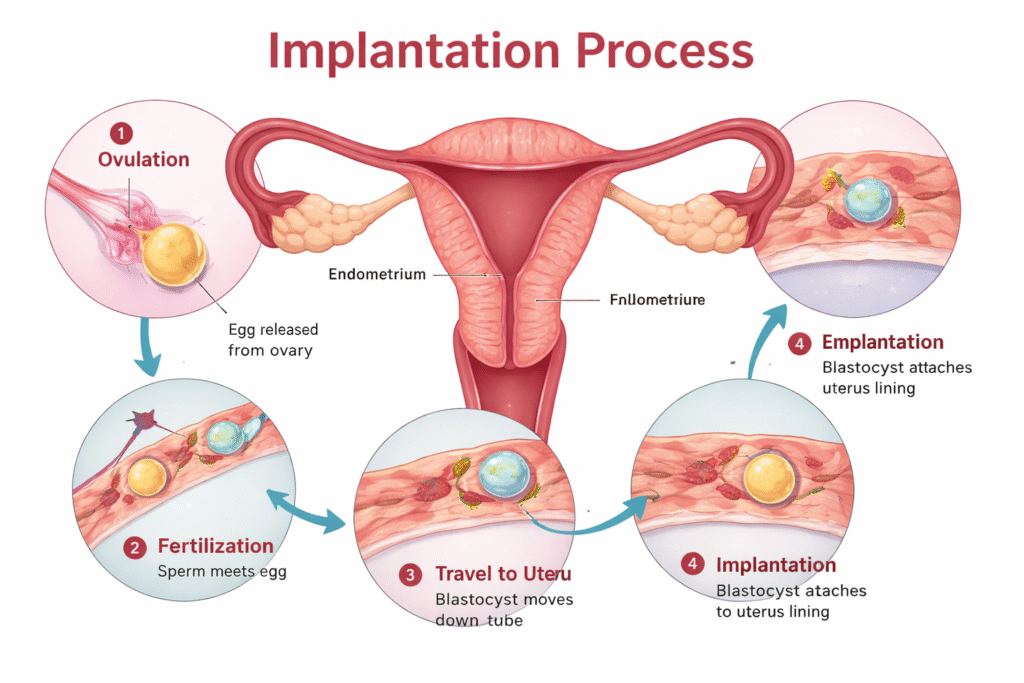
1. Fertilization The sperm meets the egg in the fallopian tube, forming a single cell called a zygote.
2. Cell Division The zygote begins dividing rapidly into multiple cells as it moves toward the uterus.
3. Blastocyst Formation By day 5, the structure becomes a blastocyst, made up of an inner cell mass that will become the baby and an outer layer that will later form the placenta.
4. Travel to the Uterus The blastocyst continues moving toward the uterus, where it will eventually settle.
5. Attachment The blastocyst attaches itself to the uterine lining, marking the start of implantation.
6. Embedding It embeds deeper into the lining to establish a strong and stable connection with the mother’s blood supply.
7. Hormone Production The body begins producing hCG, the hormone that supports early pregnancy and is what pregnancy tests detect.
Common Signs of Implantation
Some women notice subtle signs during implantation, while others feel nothing at all.
Possible symptoms include:
- Light spotting (implantation bleeding)
- Mild abdominal cramping
- Slight rise in basal body temperature
- Breast tenderness
- Fatigue
- Mood changes
These symptoms are usually mild and short-lived.
👉 For a detailed breakdown, you can read about implantation symptoms day by day.
What is Implantation Bleeding?
Implantation bleeding is light spotting that some women experience when the fertilized egg attaches to the uterine lining. It’s usually much lighter than a regular period and often appears as pink or light brown discharge rather than the bright or dark red flow typical of menstruation.
It typically lasts anywhere from a few hours to two or three days, and it doesn’t require any treatment on its own. Many women mistake it for the start of their period, especially since it can happen around the same time their period would normally be due.
Not sure if what you’re seeing is implantation bleeding or your period? Check our Implantation Bleeding Vs Period Bleeding guide or try the Implantation Vs Period Calculator for a quick answer.
Implantation vs Period: Key Differences
| Feature | Implantation | Period |
|---|---|---|
| Flow | Very light | Moderate to heavy |
| Color | Pink or brown | Bright or dark red |
| Duration | 1–2 days | 3–7 days |
| Clots | Rare | Common |
What Happens If Implantation Fails?
What Happens If Implantation Fails?
If implantation doesn’t happen or fails shortly after starting, the fertilized egg doesn’t survive, and the body sheds the uterine lining as usual, resulting in a period. In most cases, this happens so early that a woman never even knows fertilization occurred.
Sometimes implantation begins but doesn’t fully succeed. This can result in a very early pregnancy loss, often called a chemical pregnancy, where a woman might get a faint positive test followed by her period arriving shortly after. Our Chemical Pregnancy article explains this in more detail, including what signs to look for and when it’s worth talking to a doctor.
Failed implantation is usually caused by chromosomal abnormalities in the embryo, hormonal imbalances, or issues with the uterine lining itself. In most cases, it isn’t something a woman could have prevented or caused.
Factors That Affect Implantation
Several factors can influence whether implantation is successful:
- Uterine lining thickness
- Hormonal balance
- Egg quality
- Sperm quality
- Overall reproductive health
Maintaining a healthy lifestyle may support better reproductive outcomes. If you’re going through fertility treatments like IVF, our IVF Early Pregnancy Symptoms article can help you understand what to expect after transfer.
When Should You Take a Pregnancy Test?
Pregnancy tests detect hCG, which is only produced after implantation.
For accurate results:
- Wait at least 10–14 days after ovulation
- Or test after a missed period
Testing too early may result in a false negative, even if you are actually pregnant, since hCG levels are still too low to detect. Testing first thing in the morning also improves accuracy, since urine is more concentrated at that time.
For a more detailed breakdown of exact timing based on your cycle, our When to Take a Pregnancy Test article walks you through it step by step
Tips to Support Implantation
While implantation cannot be controlled directly, you can support your body by:
- Eating a balanced diet
- Managing stress
- Staying hydrated
- Avoiding smoking and alcohol
- Getting enough rest
These habits help create a healthy environment for pregnancy.
Final Thoughts
Implantation is a small but crucial step in the early days of pregnancy. Understanding when it happens, what signs to watch for, and how it differs from a regular period can help you make sense of what your body is going through, especially in those uncertain days before a missed period.
If you’re actively trying to conceive, tracking your cycle closely can make this waiting period a little easier. Our Implantation Calculator and Ovulation Calculator can help you estimate your window more accurately, so you know roughly when to expect symptoms or when it might be the right time to test.
Get Weekly Pregnancy & Fertility Tips
Get helpful, evidence-based insights on implantation, early pregnancy, fertility, ovulation, and pregnancy testing, delivered straight to your inbox every week.
Frequently asked Questions
What is implantation bleeding?
Implantation bleeding is light spotting that can happen when a fertilized egg attaches to the lining of the uterus, usually around 6–12 days after ovulation.
When does implantation occur?
Implantation usually occurs about 6 to 12 days after ovulation, when the fertilized egg attaches to the uterine lining.
How long does implantation last?
Implantation typically lasts 1 to 3 days, during which the fertilized egg attaches to the uterine lining and may cause light spotting.
Does implantation always cause symptoms?
No, implantation does not always cause noticeable symptoms. Some people may experience light spotting or mild cramping, while many have no symptoms at all.
Can I take a pregnancy test during implantation?
It’s usually too early to take a pregnancy test during implantation. Pregnancy tests detect hCG hormone, which typically rises a few days after implantation, so testing is more reliable after a missed period.
Can implantation cause cramps?
Yes, mild cramping can occur during implantation.
How long after implantation can you test positive?
Most women can get an accurate positive result about 3 to 4 days after implantation, since it takes a little time for hCG levels to build up enough to be detected by a home test.
Can you feel implantation happening?
Some women notice mild cramping or light spotting around implantation, but many feel nothing at all. Not feeling anything doesn’t mean implantation isn’t happening.
Is implantation bleeding heavy or light?
Implantation bleeding is usually very light, often just spotting, and much lighter than a normal period flow.
Can implantation happen without any symptoms?
Yes, many women experience no symptoms at all during implantation, and this is completely normal. Symptoms are not a reliable way to confirm implantation.
How many days does implantation take from start to finish?
The attachment and embedding process usually takes a few days, though the entire window from ovulation to implantation can range between 6 to 12 days.