
When to Take a Pregnancy Test: Best Time, Accuracy, and What to Expect

Finding out whether you are pregnant can be exciting, overwhelming, and a little nerve-wracking at the same time. Knowing when to take a pregnancy test and understanding how it works can help you get accurate results and plan your next steps. This guide covers everything from early signs of pregnancy to the different types of tests, their accuracy, and what to do after a positive result. Understanding when to take a pregnancy test helps reduce confusion and increases the chance of getting an accurate result.
What Is a Pregnancy Test and When Should You Take One
A pregnancy test is a medical test that checks for the presence of **human chorionic gonadotropin (hCG)**, a hormone produced shortly after a fertilized egg implants into the uterus. Detecting hCG confirms pregnancy. Pregnancy tests are available in two main forms: home urine tests and clinical blood tests. Home tests are convenient, private, and easy to perform, while blood tests are more sensitive and can detect pregnancy earlier than urine tests. Both methods are highly reliable when used correctly, but **timing and proper technique** are crucial for accurate results.
Key points about pregnancy tests: Detect the hormone hCG to confirm pregnancy. * Home urine tests are quick, private, and widely available. * Blood tests are more sensitive and can detect pregnancy sooner. * Accuracy depends on following instructions and testing at the right time.
How Pregnancy Test Work
Pregnancy tests work by detecting the presence of hCG, which starts rising shortly after implantation. The hormone typically doubles every 48–72 hours, allowing early detection. Urine tests measure hCG in urine, with first-morning urine being the most concentrated and ideal for testing. Blood tests measure hCG levels in the bloodstream and can detect pregnancy even before a missed period.
Some blood tests are qualitative, giving a simple yes/no answer, while others are quantitative, measuring the exact hCG level. It’s important to note that testing too early can lead to a false negative because hCG levels may still be too low to detect. Following instructions carefully and testing at the right time maximizes accuracy.
Knowing when to take a pregnancy test is important because hCG levels rise gradually after implantation.
Signs That Indicate When to Take a Pregnancy Test
Certain symptoms can indicate that you may be pregnant. While these vary from person to person, there are several common early signs:
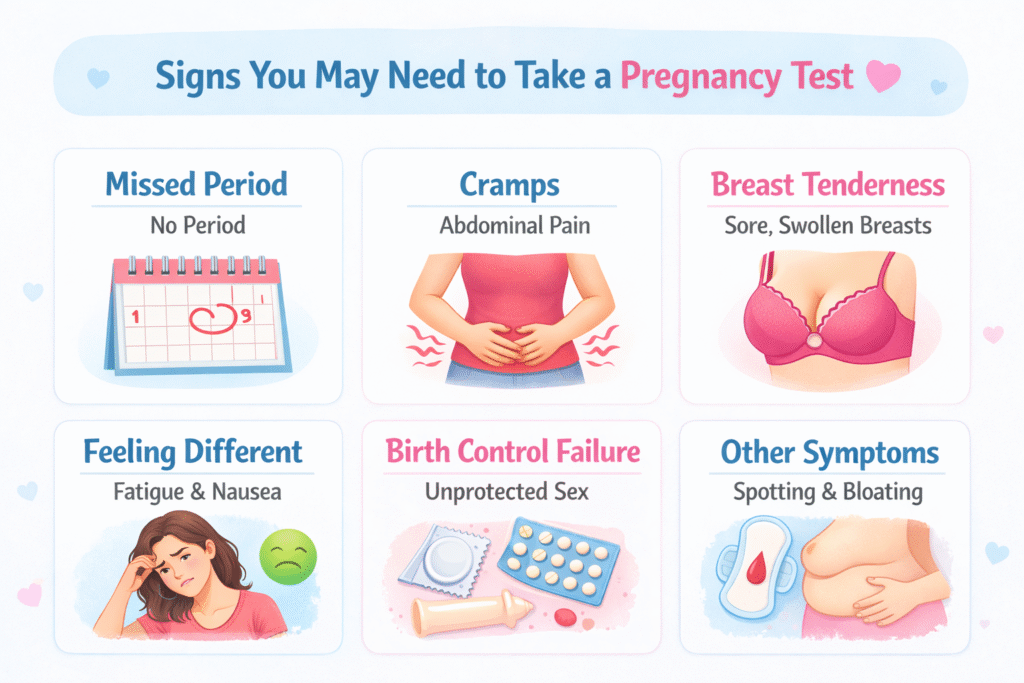
Missed Period: Often the first and most obvious sign.
Cramps: Mild abdominal cramping due to implantation.
Breast Tenderness: Swelling or soreness caused by hormonal changes.
Feeling Different: Fatigue, mood swings, or nausea.
Birth Control Failure: Unprotected intercourse or contraceptive failure increases the risk. Some people also notice light spotting, bloating, or unusual digestive changes. Recognizing these signs can help you decide when it’s appropriate to take a pregnancy test.
Early pregnancy symptoms often begin around implantation, and our implantation calculator can help you estimate when this may have occurred. According to medical experts, implantation usually occurs several days after ovulation, a process also explained by trusted sources like Mayo Clinic.
When Should You Take a Pregnancy Test for Accurate Results
Many people wonder when to take a pregnancy test after ovulation or a missed period to avoid false results.
Timing your test correctly is crucial. Testing too early may result in a false negative, while testing too late can delay pregnancy confirmation. Most pregnancy tests are most accurate after a missed period, when hCG levels have risen enough to be detected. Although some early detection tests claim to identify pregnancy up to six days before a missed period, their accuracy is usually lower at this stage. Testing just a few days after intercourse is generally not recommended because hCG levels are often too low to be detected.
Guidelines for testing:
Wait at least one to two weeks after ovulation or until your missed period
If you have irregular cycles, wait around 21 days after unprotected intercourse for better accuracy
Early detection tests can be used cautiously, but results should be confirmed later
Best Time of Day to Take a Pregnancy Test
The best time to take a pregnancy test is usually in the morning when urine is most concentrated. The concentration of hCG in urine varies throughout the day, which makes timing an important factor for accurate results. First-morning urine is usually recommended because it contains the highest concentration of hCG. Drinking large amounts of water before testing can dilute urine and reduce test accuracy. Although pregnancy tests can be taken later in the day, morning testing is generally more reliable, especially during early pregnancy. Proper timing helps improve result accuracy and reduces the risk of false negatives.
Important timing tips:
Use first-morning urine for the most accurate results
Avoid drinking excessive fluids before testing
Morning testing is more reliable during early pregnancy
Correct timing lowers the chance of false negative results
Types of Pregnancy Tests and When to Use Each
Pregnancy tests are available in different types, each designed to detect the hormone hCG in slightly different ways. Choosing the right test depends on how early you want to detect pregnancy and how accurate you need the result to be. Some tests are convenient for home use, while others are more sensitive and performed in medical settings.
Common types of pregnancy tests include:
At-home urine pregnancy tests:
These are the most widely used tests and are easily available at pharmacies. They are convenient, private, and simple to use. When used correctly after a missed period, they can be up to 99% accurate.Blood pregnancy tests:
Performed in a clinic or laboratory, blood tests are more sensitive than urine tests and can detect pregnancy earlier. They can be qualitative (confirming pregnancy with a yes or no result) or quantitative (measuring the exact level of hCG in the blood).Early detection pregnancy tests:
These tests are designed to detect lower levels of hCG and may identify pregnancy before a missed period. However, they are more likely to give false negative results and usually require confirmation with another test later.
How to Perform a Pregnancy Test Correctly
Performing a test correctly is essential for accurate results. For home urine tests:
Wash your hands thoroughly.
Collect urine in a clean cup or hold the test stick directly in your urine stream.
Wait for the recommended time before reading the result.
Follow the instructions on the package carefully.
If the result is unclear, wait a day or two and retest, or consult a healthcare professional for a blood test. Proper technique and timing ensure reliability.
Reading the Results
Understanding the results is critical. Most home tests display results as lines, symbols, or words.
A positive result indicates hCG is present and suggests pregnancy.
A negative result means no detectable hCG.
Occasionally, results may appear unclear, which may require a repeat test or confirmation with a doctor. False positives are rare but can happen due to medications, recent pregnancy loss, or certain medical conditions. False negatives are more common if testing too early or with diluted urine. Knowing these possibilities helps manage expectations.
Factors Affecting Accuracy
Testing at the right time to take a pregnancy test significantly improves overall accuracy. Several factors can affect test accuracy. Medications containing hCG, commonly used in fertility treatments, may cause false positives. Testing too early can lead to false negatives because hCG levels might not be high enough. Conditions like ectopic pregnancy may also affect results. Improper test usage, such as not following instructions or using diluted urine, can further reduce accuracy. To ensure reliable results, test at the recommended time, use first-morning urine, and follow instructions closely.
What to Do After a Positive Test
A positive pregnancy test should be followed by a visit to a healthcare provider to confirm pregnancy and start prenatal care. Early medical care is essential for the health of both the parent and the baby. Avoid alcohol, tobacco, and unapproved medications. Monitoring symptoms and following medical guidance ensures proper care and identifies any potential complications early. Confirmation with a blood test can provide additional certainty, and keeping track of early symptoms helps detect any issues promptly.
Summary
Taking a pregnancy test at the right time and using the correct method is crucial for accurate detection. Missed periods, first-morning urine, and reliable test methods increase accuracy, while recognizing early signs of pregnancy helps guide testing. Following up with a healthcare provider ensures proper care and a safe start to pregnancy. Understanding these steps makes the process of confirming pregnancy less stressful and more reliable.
Our Tools & Calculators
These tools help you understand when to take a pregnancy test based on ovulation, implantation, and cycle timing.