
Complete Pregnancy & Fertility Calculator Guide: Ovulation, Implantation, IVF & Due Date Explained
Understanding pregnancy is not just about getting a positive test, it is about understanding timing. Every stage, from ovulation to implantation and finally to delivery, follows a biological sequence. The challenge most women face is not lack of information, but lack of clarity. Different tools, different timelines, and different symptoms often create confusion instead of answers.
This is exactly why pregnancy and fertility calculators exist. Instead of guessing what is happening inside your body, these tools help you track each stage with more accuracy. However, using a single calculator is not enough. To truly understand your fertility journey, you need to see how all these tools connect and support each other.
How the Fertility Timeline Actually Works
Every pregnancy begins with your menstrual cycle. The first day of your period marks Day 1, and from there your body prepares for ovulation. Ovulation is the most important phase because it determines when you can actually conceive.
This is where most women make their first mistake—they don’t track ovulation correctly. Without knowing your fertile window, the chances of conception drop significantly. To solve this, you should start with the ovulation calculator (insert link: /ovulation-calculator), which estimates your ovulation day and highlights your most fertile days based on your cycle.
Once ovulation occurs, the egg remains viable for about 24 hours. If sperm is present during this window, fertilization can happen. But even after fertilization, pregnancy does not begin immediately.
Implantation: The Real Start of Pregnancy
After fertilization, the embryo travels toward the uterus. This journey takes several days, and during this time, there are usually no noticeable symptoms. The real beginning of pregnancy happens only when the embryo attaches to the uterine lining—a process known as implantation.
Implantation typically occurs between six to ten days after ovulation, but the exact timing varies from person to person. Because this stage is so critical, many women want to predict when it happens so they can better understand their symptoms and testing timeline.
You can estimate this phase using the implantation calculator (insert link: /implantation-calculator). This tool helps you identify your likely implantation window, which is essential for understanding when early pregnancy signs may begin and when testing might become reliable.
Implantation Bleeding vs Period: A Common Confusion
Around the time implantation occurs, some women experience light spotting. This is often mistaken for a regular period, leading to confusion and sometimes unnecessary stress. The difference between implantation bleeding and menstrual bleeding is subtle but important.
Implantation bleeding is usually lighter, shorter, and occurs earlier than a typical period. However, because every body reacts differently, it is not always easy to tell the difference based on symptoms alone.
To get a clearer idea, you can use the implantation vs bleeding calculator (insert link: /implantation-vs-bleeding-calculator). This tool evaluates timing, flow, and symptom patterns to help you understand whether the bleeding you’re experiencing is more likely related to implantation or your cycle.
When Pregnancy Becomes Detectable
After implantation, your body begins producing the hormone hCG, which is responsible for a positive pregnancy test. However, hCG does not rise instantly. It takes time to build up to detectable levels, which is why testing too early often results in false negatives.
Most pregnancy tests become reliable around 10 to 14 days after ovulation. This timing is directly linked to implantation, which is why understanding implantation timing through the implantation calculator is so important.
At this stage, many women start looking ahead and asking the next logical question: when is the baby due?
Calculating Your Due Date Accurately
Once pregnancy is confirmed, estimating the due date becomes the next priority. In natural pregnancies, this is usually calculated based on the first day of your last menstrual period, using a standard 40-week model.
While this method works for many women, it assumes a regular cycle and average ovulation timing. If your cycle varies, the estimate may not be perfectly accurate. To get a more personalized result, you should use the due date calculator (insert link: /due-date-calculator), which provides a clearer projection of your expected delivery date based on your individual data.
IVF Pregnancy: Why Standard Calculations Don’t Work
If you conceived through IVF, the timeline changes significantly. Instead of ovulation, the key event becomes embryo transfer. Because the embryo has already developed outside the body before transfer, the pregnancy timeline is effectively shifted forward.
For example, in a 5-day embryo transfer, the embryo is already five days developed at the time of transfer. This means traditional due date calculations based on LMP are not accurate for IVF pregnancies.
To solve this, you need a specialized tool like the IVF due date calculator (insert link: /ivf-due-date-calculator). This calculator adjusts for embryo age and transfer timing, giving you a far more precise due date tailored specifically for IVF.
How All These Calculators Work Together
One of the biggest mistakes people make is using these tools in isolation. In reality, they are designed to work together as a complete system.
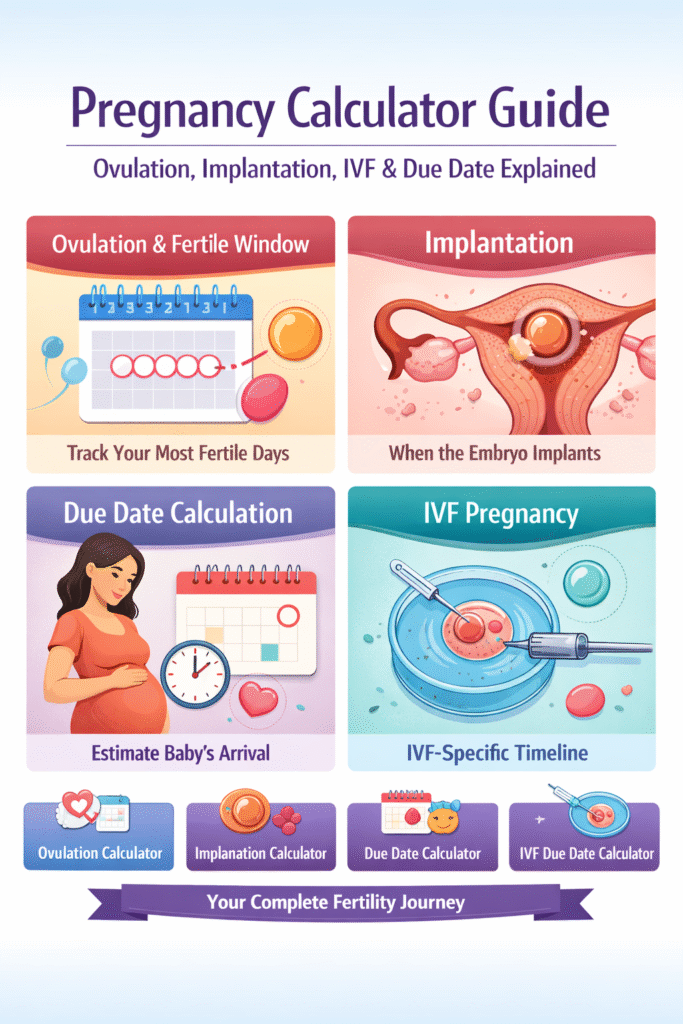
You begin with the ovulation calculator to identify your fertile window. After ovulation, the implantation calculator helps you understand when pregnancy may begin. If you experience spotting, the implantation vs bleeding calculator helps you interpret what your body is telling you. Once pregnancy is confirmed, the due date calculator gives you a long-term timeline, while IVF patients rely on the IVF due date calculator for accuracy.
When you connect these tools, you move from guesswork to a structured understanding of your fertility journey. This not only improves accuracy but also builds confidence in every stage of the process.
Are Pregnancy Calculators 100% Accurate?
It is important to understand that no calculator can guarantee exact results. These tools are based on biological averages, and every body is different. Factors such as irregular cycles, delayed ovulation, and hormonal variations can affect timing.
However, when used correctly, these calculators provide highly reliable estimates that are extremely useful for planning and tracking. Medical confirmation through ultrasound remains the most accurate method, but calculators serve as a strong and practical starting point.
Final Thoughts
Pregnancy is a timeline-driven process, and understanding that timeline can remove a lot of uncertainty. Instead of relying on guesswork or incomplete information, using the right combination of tools allows you to follow each stage with clarity.
Whether you are trying to conceive, tracking early symptoms, or planning ahead after a confirmed pregnancy, tools like the ovulation calculator, implantation calculator, implantation vs bleeding calculator, due date calculator, and IVF due date calculator can guide you through every step.
Start with the tool that matches your current stage, and gradually use the others to build a complete picture of your journey. With the right approach, what once felt confusing can become structured, predictable, and far easier to manage.
FAQs
What is the most accurate pregnancy calculator?
The most accurate calculator depends on your situation. For natural conception, a due date calculator based on your last menstrual period works well, while IVF pregnancies require an IVF-specific due date calculator based on embryo transfer timing.
When should I use an ovulation calculator?
You should use an ovulation calculator when you are trying to conceive and want to identify your fertile window. It helps you determine the best days to increase your chances of pregnancy.
How many days after ovulation does implantation occur?
Implantation usually occurs between 6 to 10 days after ovulation, although this can vary depending on individual biological factors.
Can implantation bleeding be mistaken for a period?
Yes, implantation bleeding is often confused with a period because both involve spotting. However, implantation bleeding is usually lighter and shorter in duration.
How accurate is a due date calculator?
Due date calculators provide estimates based on average pregnancy length. For medical accuracy, ultrasound confirmation is recommended.
Is IVF pregnancy timing different from natural pregnancy?
Yes, IVF pregnancy timing is based on embryo transfer rather than ovulation, which is why IVF-specific calculators are more accurate.